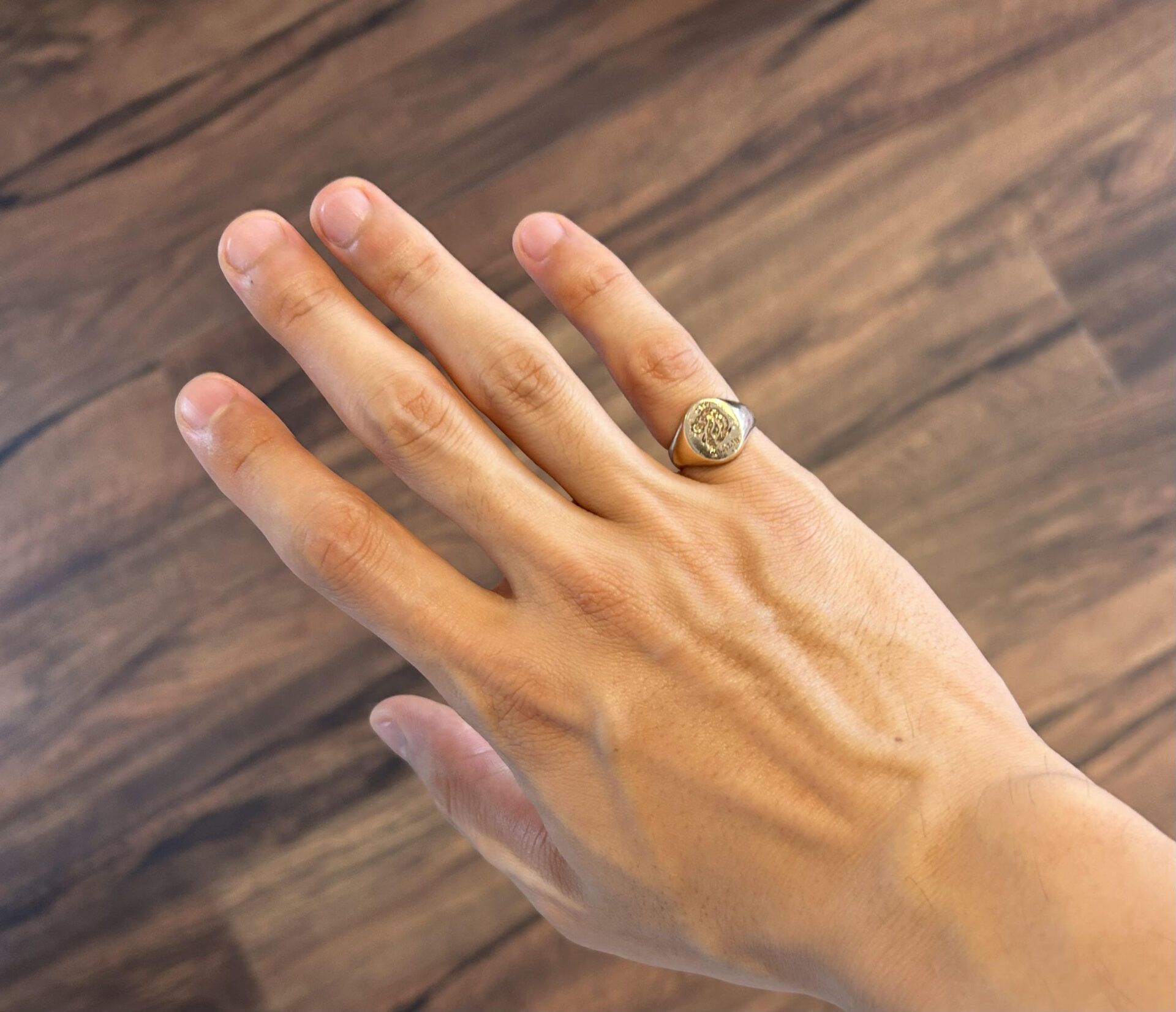
Hello, this is Mr. Linen.
When you pursue classic style and look at well-dressed gentlemen from the past in films and photographs, you often notice they wear gold rings that are different from wedding bands.
Even today, King Charles of the United Kingdom is always seen wearing a ring on his left pinky finger.

As many of you may know, this is called a signet ring.
Admiring these elegant gentlemen and always trying to emulate their style, I couldn’t resist and finally bought a signet ring myself.
However, it doesn’t suit me at all.
So I’d like to think about how to style it—and whether it even makes sense for an ordinary person to wear one.
What Is a Signet Ring?
Simply put, a signet ring is a ring with a flat face or plate on top.
Its origins date back thousands of years, though there are various theories about how it began.
In more recent history, nobles engraved their family crests onto the plate and wore them on their fingers.
Rather than being newly made each time, these rings were often passed down from father to son.
You may have seen scenes in movies where a letter is sealed with red wax, and a signet ring is pressed into it to leave a family crest imprint.

Originally worn only by aristocrats, signet rings gradually spread to the general public.
Unlike Japan, most people in Europe don’t have family crests, so many had nothing traditional to engrave.
In such cases, people would engrave their initials or even animal motifs instead.
By the way, which hand and finger should you wear it on?
This also varies by country and era—there is no single correct answer.
Some wear it on the ring finger, but if you follow King Charles, it would be the pinky finger of the non-dominant hand.
However, in Japan, people typically wear wedding rings on the left ring finger. For right-handed married men, this results in two rings stacking awkwardly on one hand.
In traditional British etiquette, gentlemen were not supposed to wear accessories at all—even wedding rings were considered inappropriate.
The only exception was the signet ring, as it symbolized family heritage rather than decoration. This is why the issue of overlapping with a wedding ring didn’t arise. In fact, King Charles does not wear a wedding ring.
What Type Should You Choose?
If you search for signet rings, you’ll find a wide variety of styles.
Materials range from gold to silver, with designs including initials, symbols, animals, or completely plain surfaces.
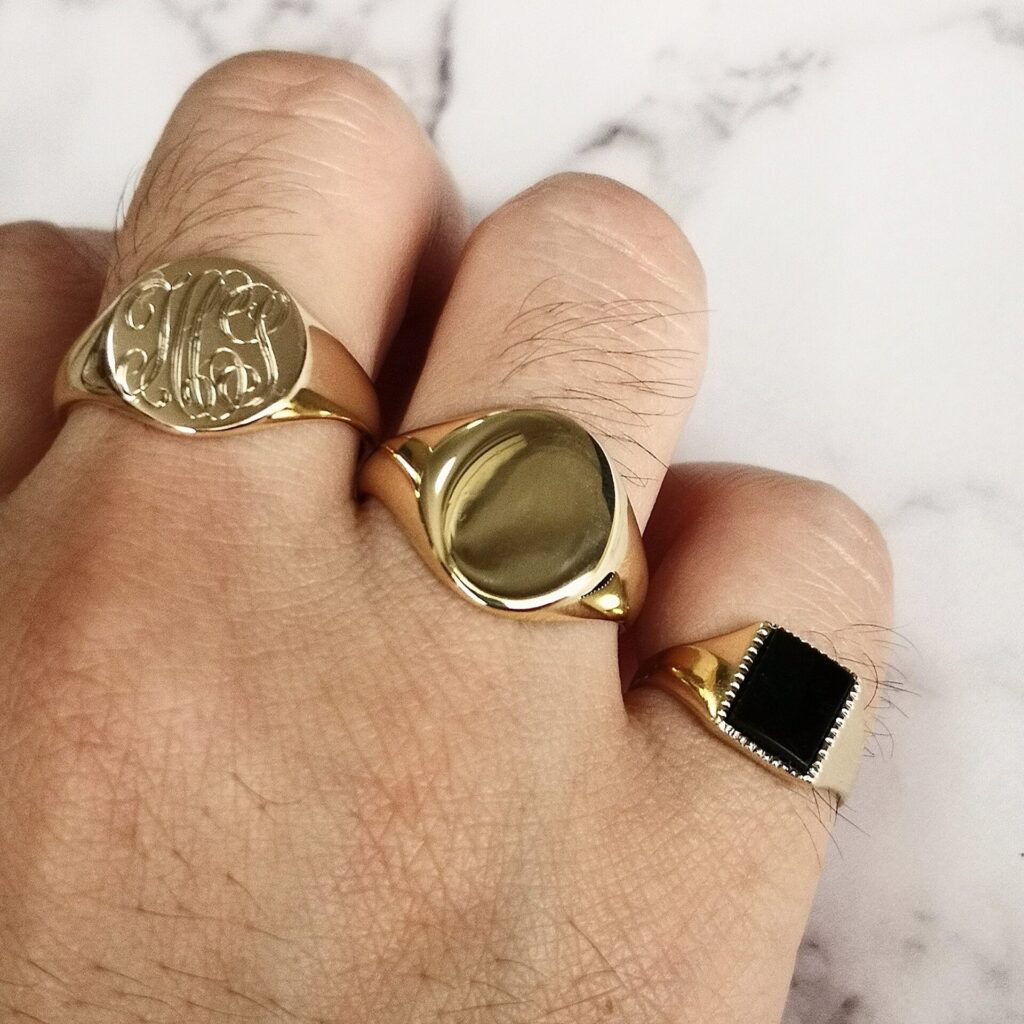
Traditionally, signet rings feature a family crest and are made of yellow gold.
In Japan, everyone technically has a family crest, but engraving a Japanese crest onto a European-origin signet ring feels somewhat mismatched to me.
That eliminates crests as an option.
The safest choice is probably initials.
Animal motifs can also work—as long as they don’t look too playful.
Flat, unengraved designs feel more like casual fashion rings than traditional signet rings, in my opinion.
As for material, I believe yellow gold is the only real choice.
Following what has historically been used feels the most authentic and classic.
While 18k gold (75% purity) is often recommended, 9k gold (37.5%) has also been widely used in the UK.
Lower gold content means higher proportions of other metals like copper or iron, making the ring harder and more durable. The color also becomes paler, slightly closer to silver.
The Signet Ring I Bought
Here is the one I bought.

I purchased it second-hand.
First, the engraving.
It features a lion.
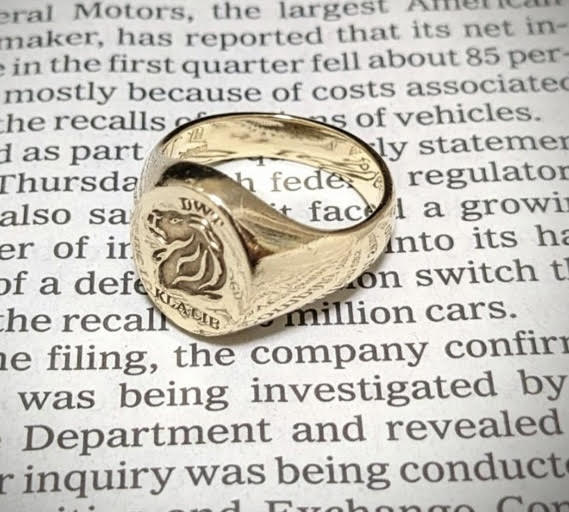
In the UK, lions are often used in heraldry as symbols of strength and nobility.
However, in my case, this is likely just a decorative design rather than an actual family crest.
That’s because both the text and image are oriented to be viewed normally from the front.
If it were meant to be used as a seal, the design would be engraved in reverse.
I kept the original engraving because I liked it. If it had been someone else’s initials, I would have re-engraved it.
Next, the material.
It is 9k yellow gold.
Precious metals are often stamped with hallmarks by official assay offices to certify their authenticity.
This ring also has several tiny hallmarks engraved inside, barely visible to the naked eye.
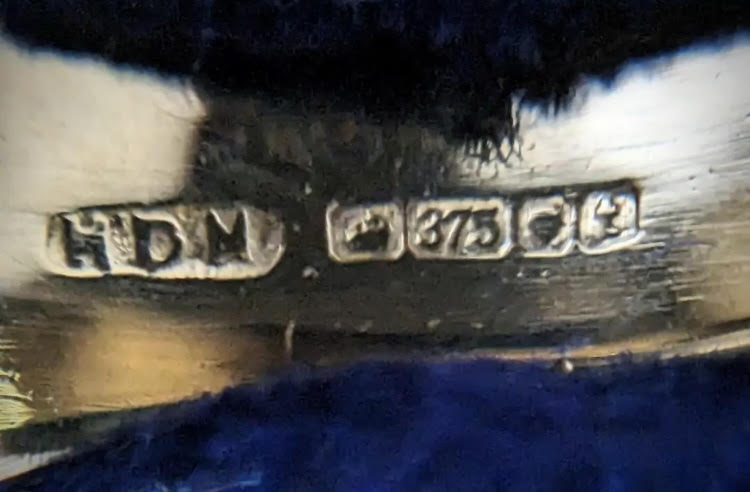
After looking them up, I confirmed it is 9k gold.
The color is indeed slightly paler than 18k gold.
It blends well with my skin tone and is arguably easier to wear than 18k.
Also, the lower gold content makes it more affordable.
An 18k ring of this size would be very expensive, but since this was second-hand, I got it at a reasonable price.
How to Style It
Even though I bought a signet ring, it’s extremely difficult to style.
I simply don’t have the maturity or presence to pull it off with a suit.
The ring stands out too much and makes me look like a tasteless rich kid.
I think I’ll let it sit for about 30 years until I grow into it (I’m currently 31).
It works better with casual outfits.
With simple looks like denim and a shirt or knit, it doesn’t feel too overbearing.
However, the moment I add a tailored jacket, it starts to feel excessive—so I treat it as a casual-only piece.
You also need to consider other accessories.
Since it’s yellow gold and fairly large, it already draws attention, so it’s best not to wear other jewelry.
If you add more gold on your wrist, neck, or other fingers, it quickly starts to look overly flashy—borderline mafia-like.
Where to Buy One
I bought mine second-hand from an online marketplace.
I used a ring sizer to measure my finger and searched for one that fits my pinky.
If you prefer trying one on in person, a well-known shop in Tokyo called Old & New is highly recommended.
They carry not only signet rings but also vintage watches and watch straps—many beautiful items.
Prices for signet rings there are likely around $700–$1,000 USD.
What about buying new instead of vintage?
That’s certainly an option.
Luxury British brand Asprey, a royal warrant holder, is considered among the finest.
However, at around $5,000–$6,000 USD, it’s extremely expensive—only for those with a generous budget.
Other brands also make new signet rings, but unless it’s a heritage brand like Asprey, the design often feels too modern and lacks a true classic character.
So realistically, I think the best approach is to find a good vintage piece and, if needed, have it re-engraved by a specialist shop.
Conclusion
A signet ring—something many men admire.
In reality, very few people (especially outside aristocratic contexts) can wear it effortlessly, so it may not be a practical purchase.
Still, if you simply want to own something you admire, it might be worth buying.
If you do decide to buy one, it’s better to do so sooner rather than later—prices will likely only rise.
Of course, there’s always the risk of losing it or outgrowing it as your fingers change over time.
That said, there are still plenty available on the vintage market, so if you’re interested, it’s worth taking a look.



コメント