Hello.
I’m Mr. Linen.
CORDINGS is a British brand that is particularly popular among people who love classic clothing, especially traditional British style.
The brand appears to make clothing using hard-wearing British fabrics such as tweed, flannel, moleskin, and Irish linen—materials that are made to be worn hard and often. Among them, its corduroy items are especially popular.
When it comes to high-quality corduroy, one name that often comes up is the prestigious British mill Brisbane Moss, and these trousers appear to be made from their corduroy.
It is also said that Brisbane Moss corduroy is used for details such as the collars of Barbour jackets.
CORDINGS makes corduroy jackets as well, but its trousers are probably the most representative item.
After actually wearing them, I would like to share what I discovered, including both the good and the bad points.
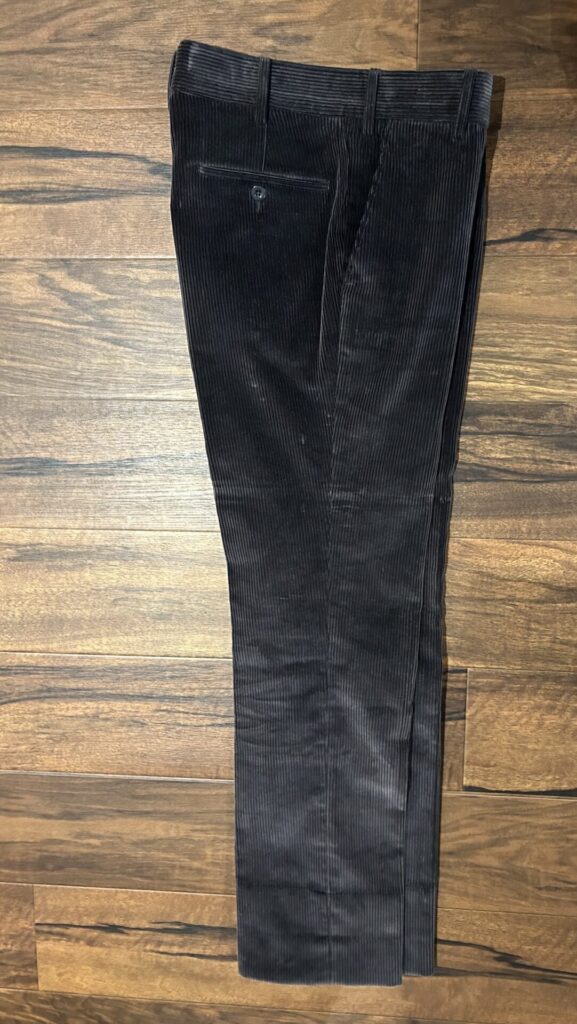
The pair I purchased has belt loops, no pleats, a fairly dark gray color, and is a size 30.
What I Like
The Quality of the Fabric
When you think of Brisbane Moss corduroy, the first thing that comes to mind is its wide wale.
It is also a substantial 17-ounce, 520g fabric with a luxurious, heavyweight feel.
Depending on the direction of the pile, the fabric has a beautiful sheen. Despite being corduroy, it does not look bulky or dowdy at all—in fact, it can look surprisingly elegant.
It Holds Its Shape Well
Because the fabric is so thick, the trousers do not easily become crumpled, allowing them to maintain a clean silhouette.
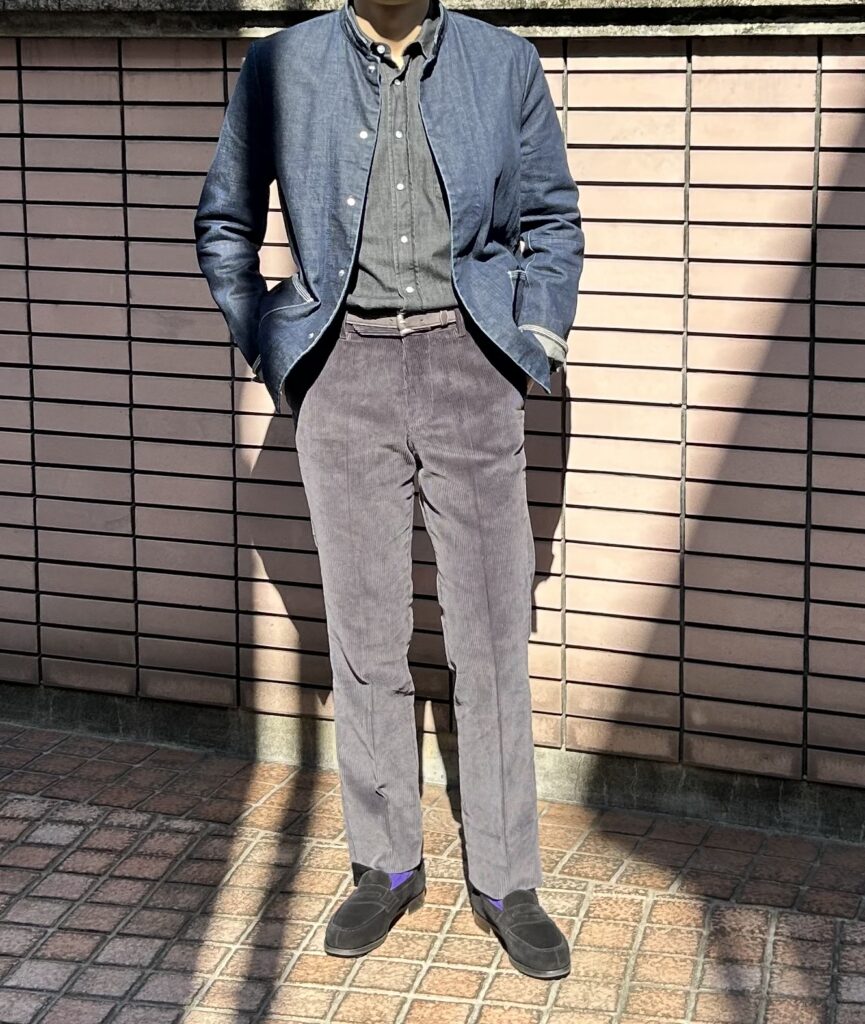
Just as with linen, thinner fabrics tend to develop finer wrinkles, which can make them look less elegant. Because this corduroy is so substantial, its wrinkles never look flimsy or poor. More importantly, the heavyweight fabric simply does not wrinkle very easily.
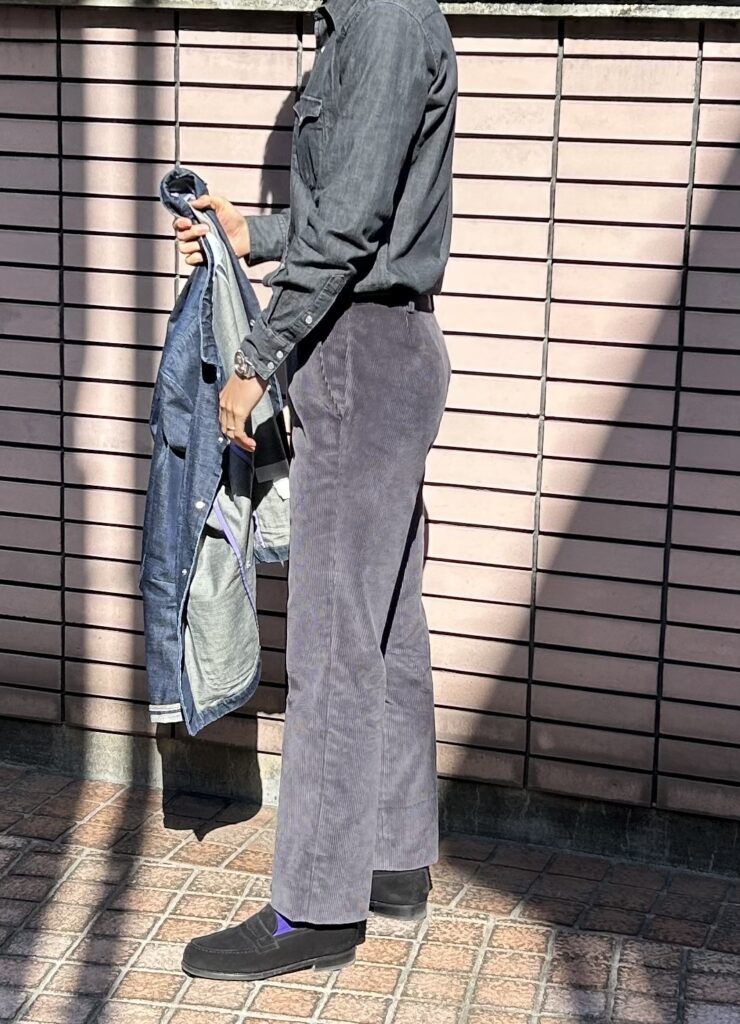
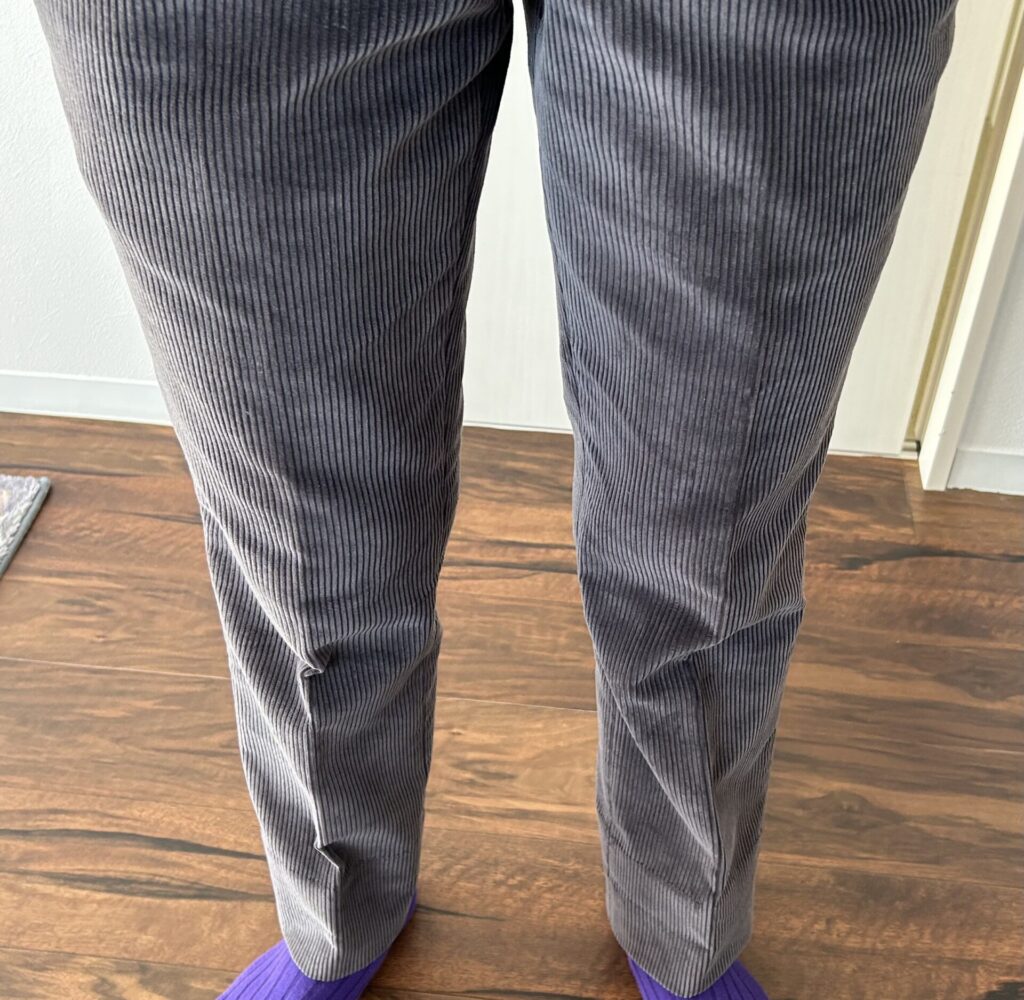
If the trousers are too long, excess fabric can bunch up around the hem. But if you have them shortened to somewhere between no break and a half break, they create a very clean shape.

A Balanced, Versatile Silhouette
Several retailers describe the silhouette as a “standard silhouette that is not affected by trends.”
That seems accurate. The trousers are neither particularly wide nor slim, the rise is neither especially high nor low, and the leg opening is neither particularly wide nor narrow.
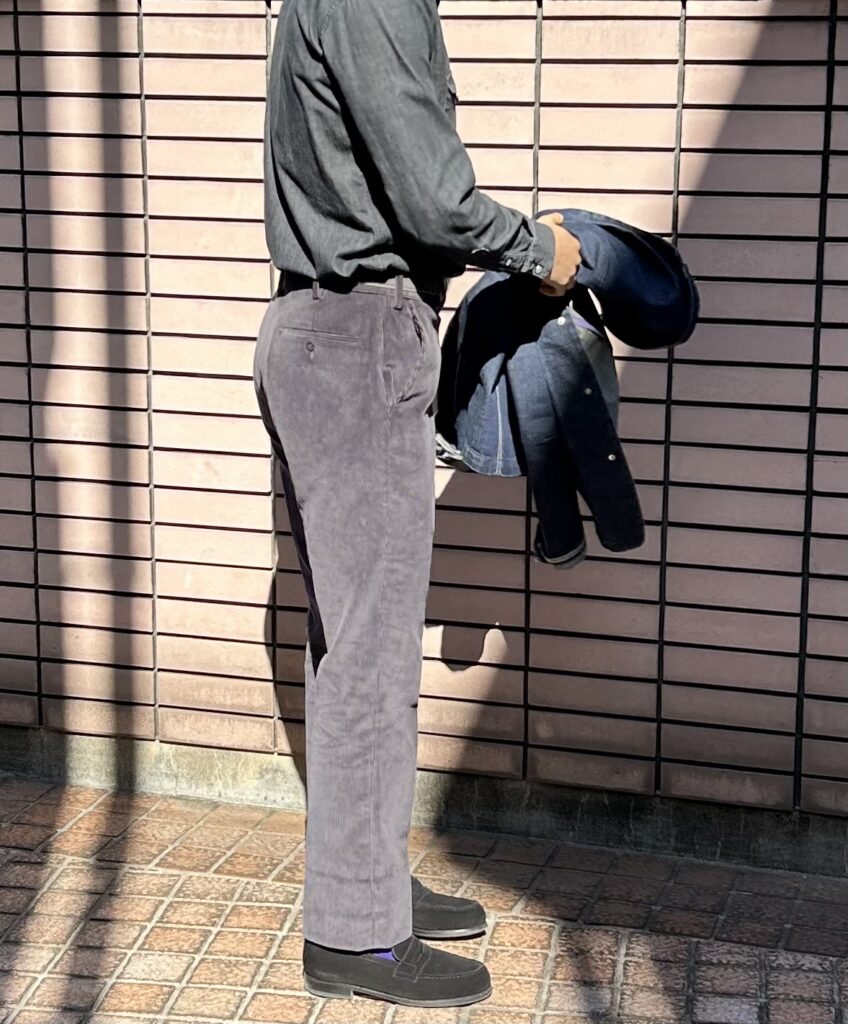
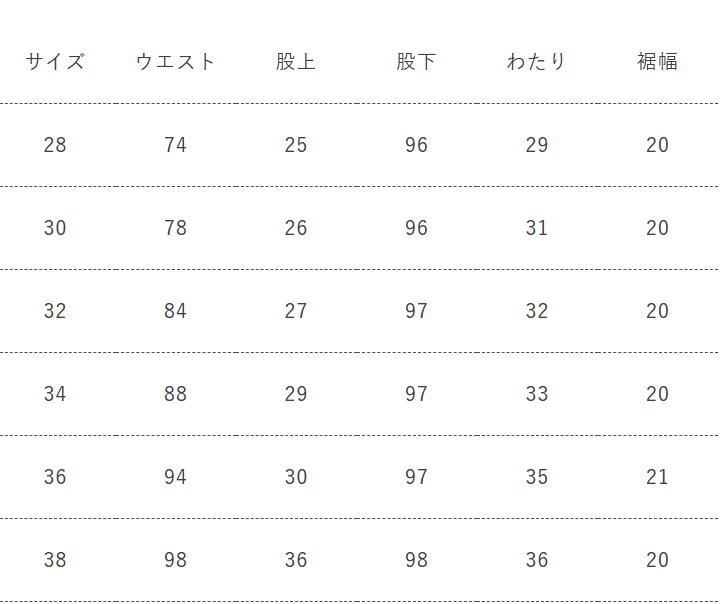
Here is the size guide.
Because the silhouette is so balanced, you are not restricted in terms of what clothes or shoes you can wear with them.
You can wear them with a shirt and jacket for a classic smart-casual look, or pair them with a knit or sweatshirt for something more relaxed.
Incidentally, I also have a pair of trousers made from a similar corduroy fabric, tailored for me by Atelier Berun. That pair has a slightly wider silhouette, with a leg opening 2 cm (0.79 in) wider than the CORDINGS pair, at 22 cm (8.66 in).
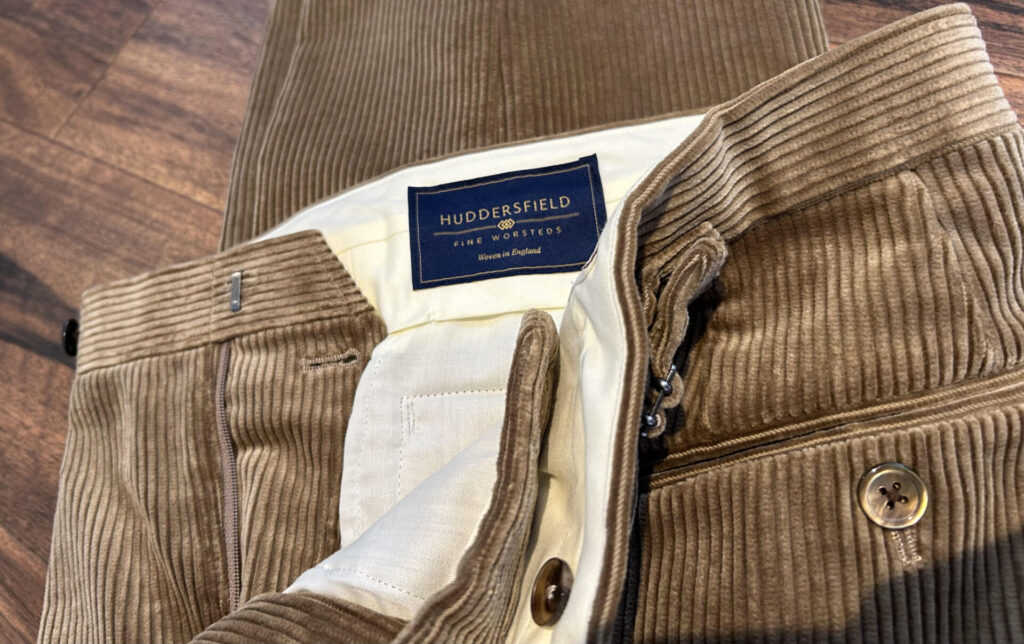
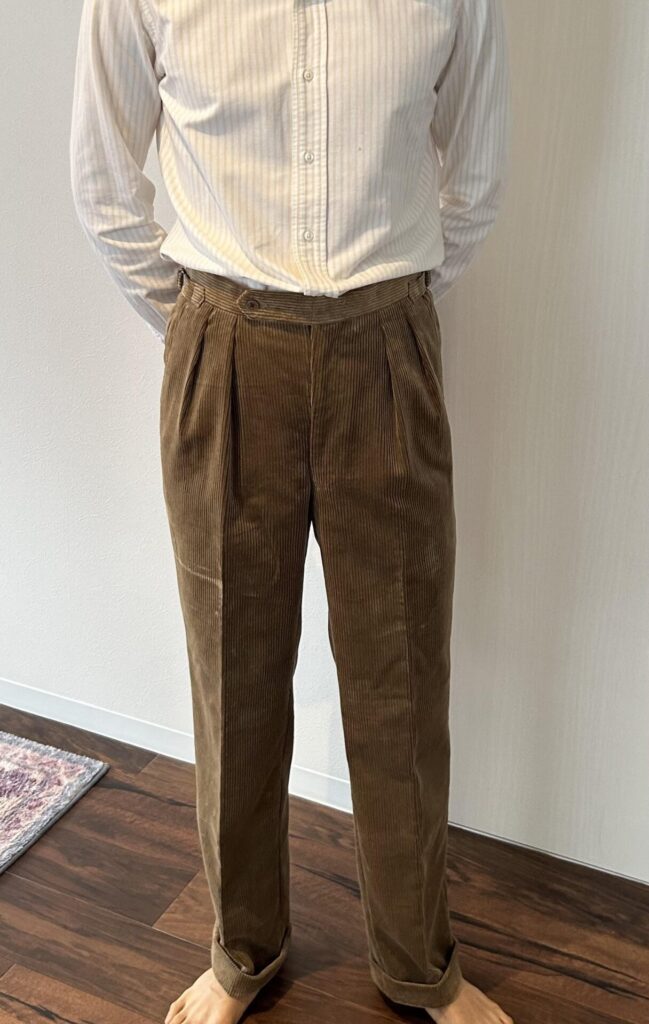
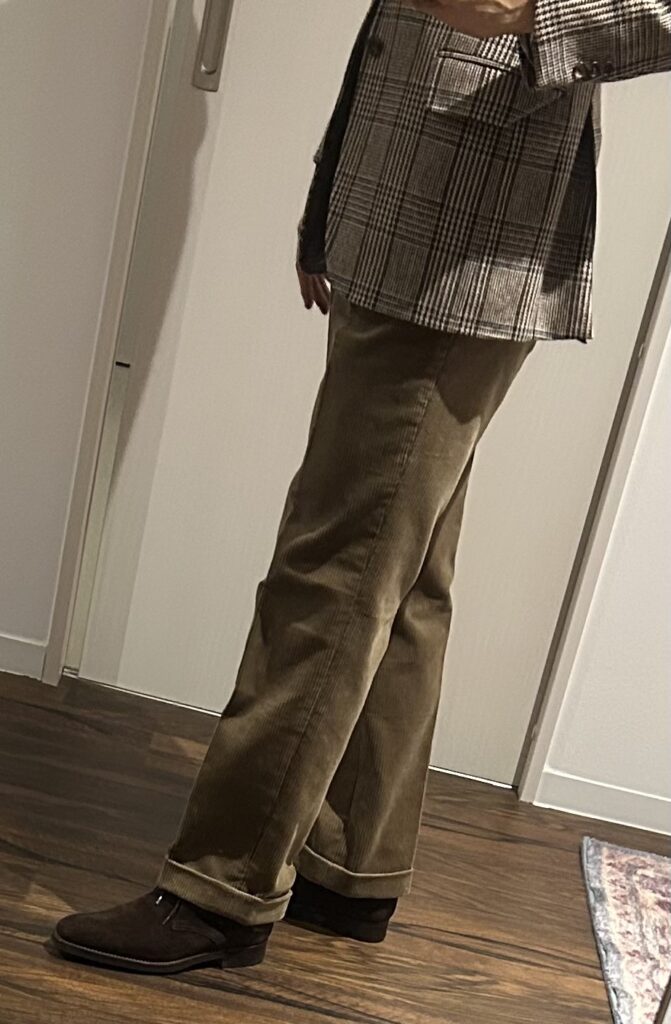
Personally, I think the CORDINGS pair could also have been just a little wider at the hem, but it is certainly not too slim, so I have no complaints.
It is also possible to have the trousers altered to make the hem slightly wider, so I may let it out a little in the future.
A Wide Range of Colors
There are nine colors available in total.
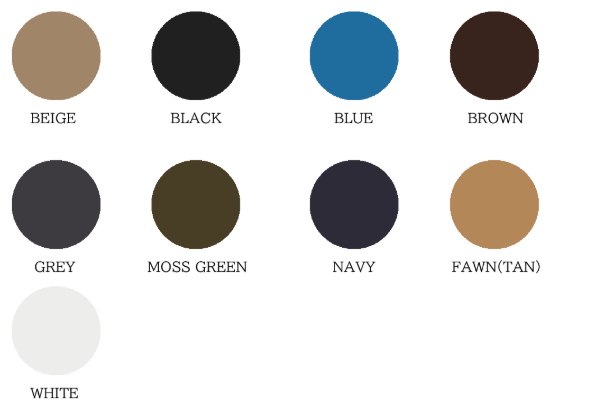
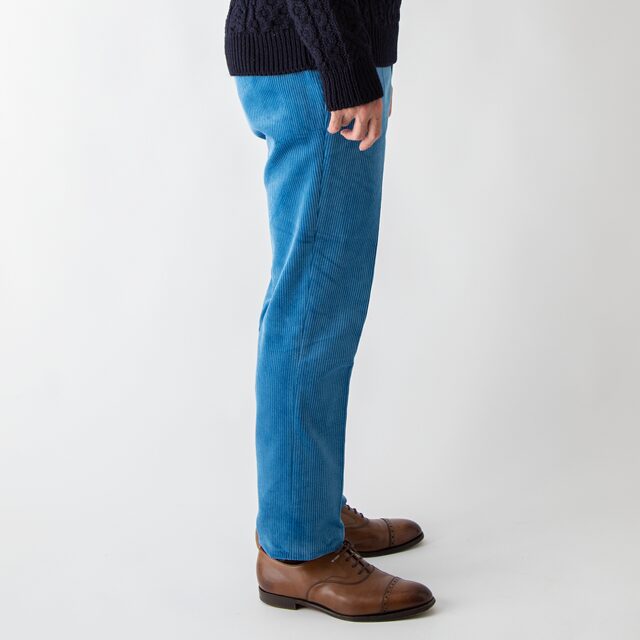
All of them are easy colors to wear in everyday life. Even the relatively brighter shades, such as blue, should be quite easy to style thanks to the elegance of the fabric and the balanced silhouette.
The One Thing I Didn’t Like
“Disappointing” may be a little too strong, but I would like to share the one detail that caught my attention.
The Rise Is Rather Low
In the section above, I described the rise as neither particularly high nor low. Compared with jeans or chinos, I would say it is fairly average. However, when compared with the trousers of a classic suit, I think it falls on the lower side.
My size 30 has a 26 cm (10.24 in) rise, with a 78 cm (30.71 in) waist.
When I actually wear them, the very top of the waistband sits about 1.2 cm (0.47 in) below my navel.
I personally would have preferred the rise to be another 1.2 cm (0.47 in) deeper.
Classic suit trousers often have a rise high enough to cover the navel, so you could say that a higher rise makes the legs appear a few centimeters longer.
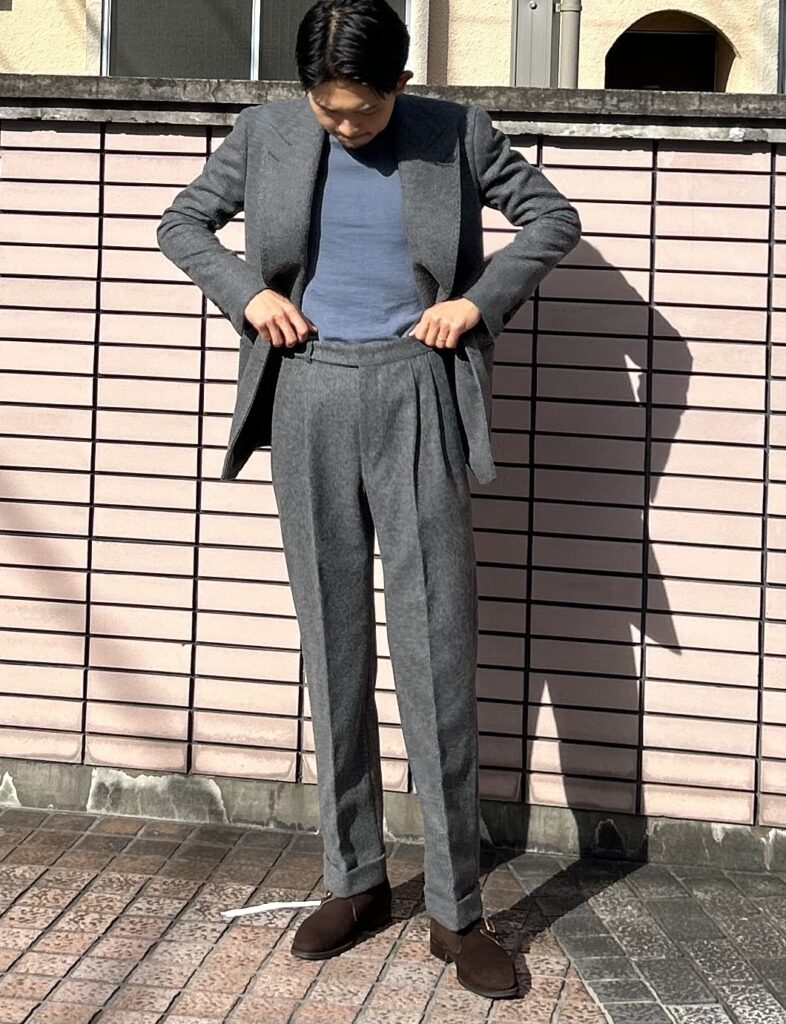
The trousers also have suspender buttons, but personally I find the combination of suspenders and a relatively low rise a little awkward, so I plan to wear mine with a belt only.
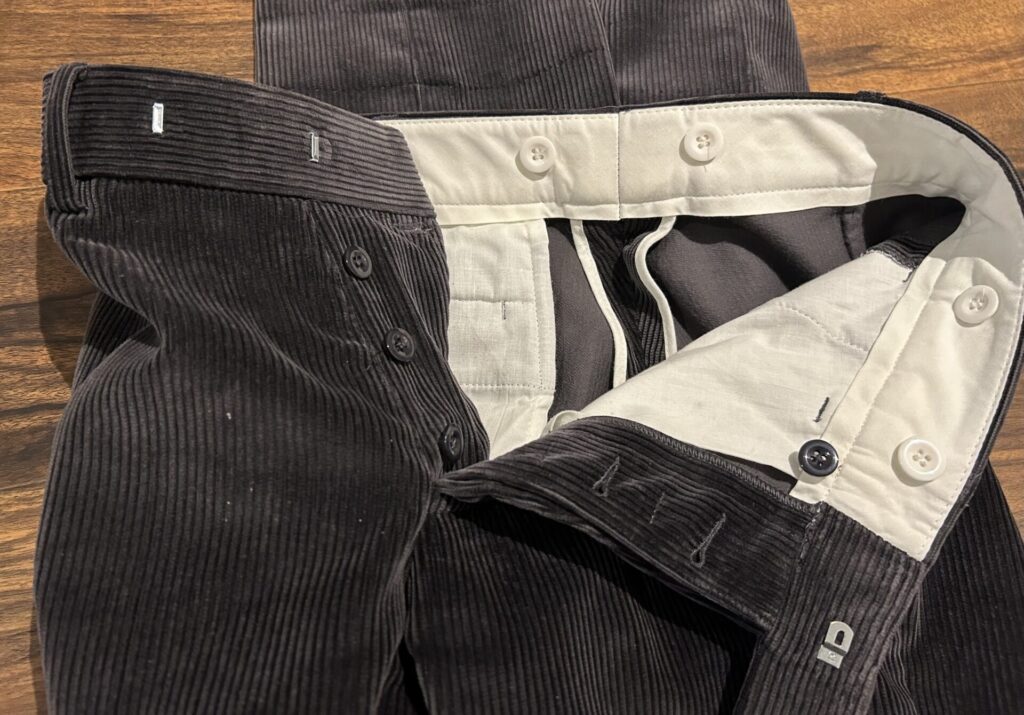
The only real drawback for me is the relatively low rise. Apart from that, I think these trousers are almost perfect.
The inside is also finished to a high standard and has a luxurious feel. I especially appreciate the reinforcement fabric inside the crotch area.
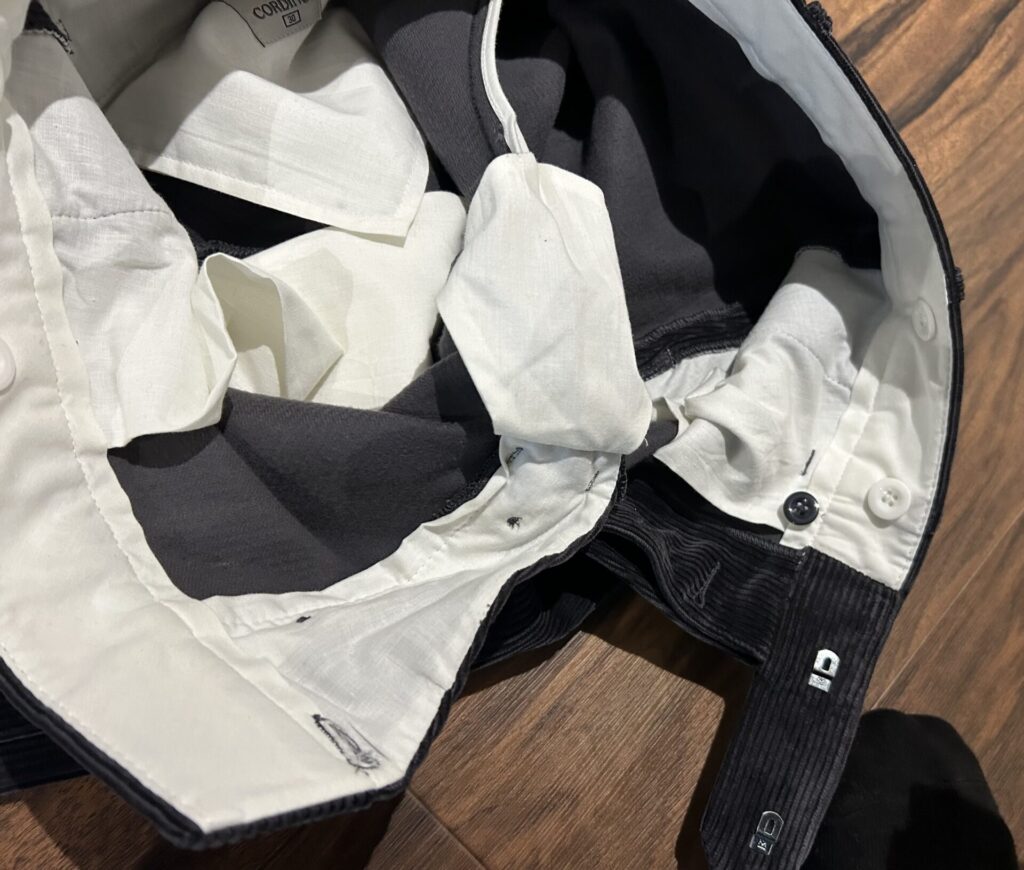
Other Small Details
Here are a few other details I noticed.
Button Fly
The front fly uses buttons rather than a zipper.
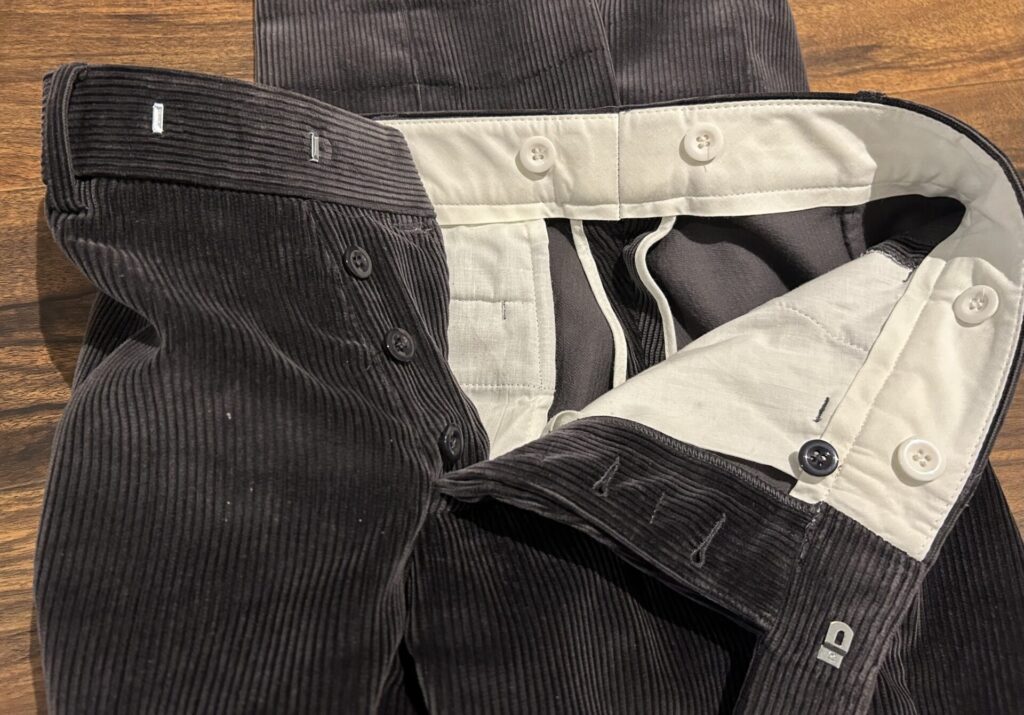
It is simply a little more cumbersome, but visually, it looks great.
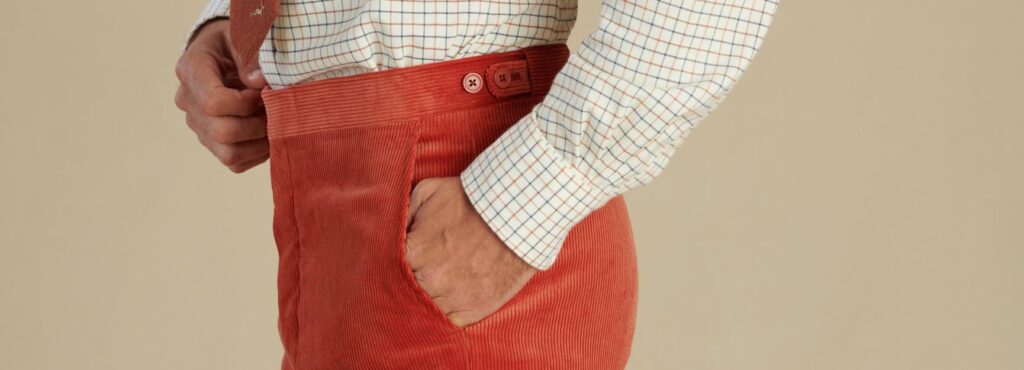
Button-Style Side Adjusters
There is also a version without belt loops, using side adjusters instead.
In that version, the side adjusters use buttons rather than traditional buckles. The button version is the main style offered in Japan.
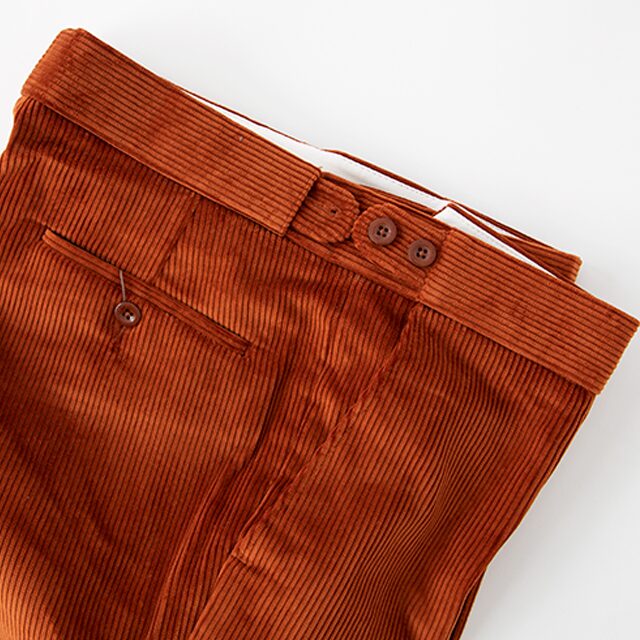
I think the traditional buckle version looks better, but with a thick, heavily brushed fabric like this, the fabric does not slide easily through a buckle, making it difficult to tighten or loosen the waist.
So from a functional point of view, the button system actually makes sense.
The Waistband Is Wide
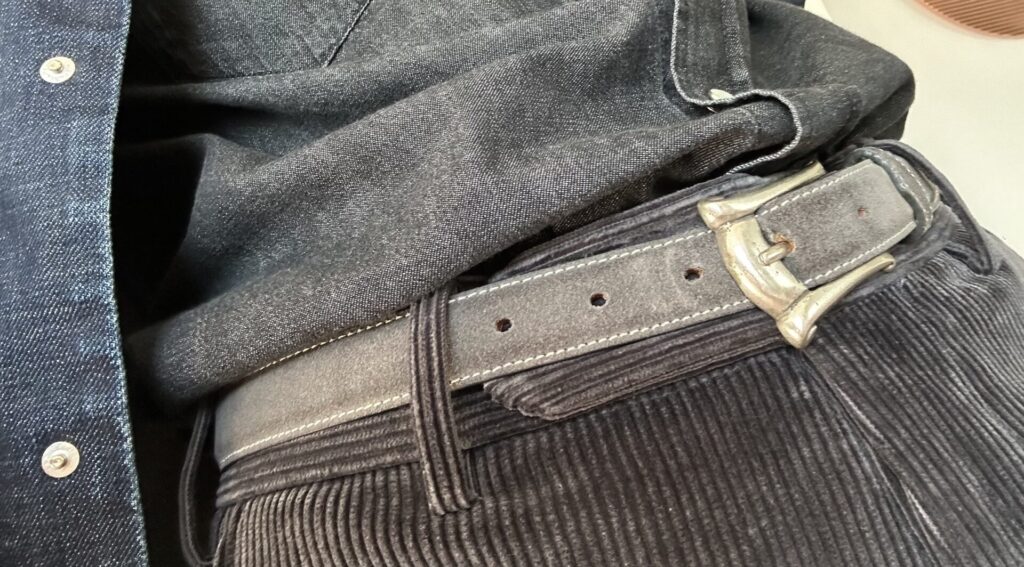
The waistband—the band of fabric around the waist that sits underneath the belt—is slightly wider than usual, measuring 4.5 cm (1.77 in).
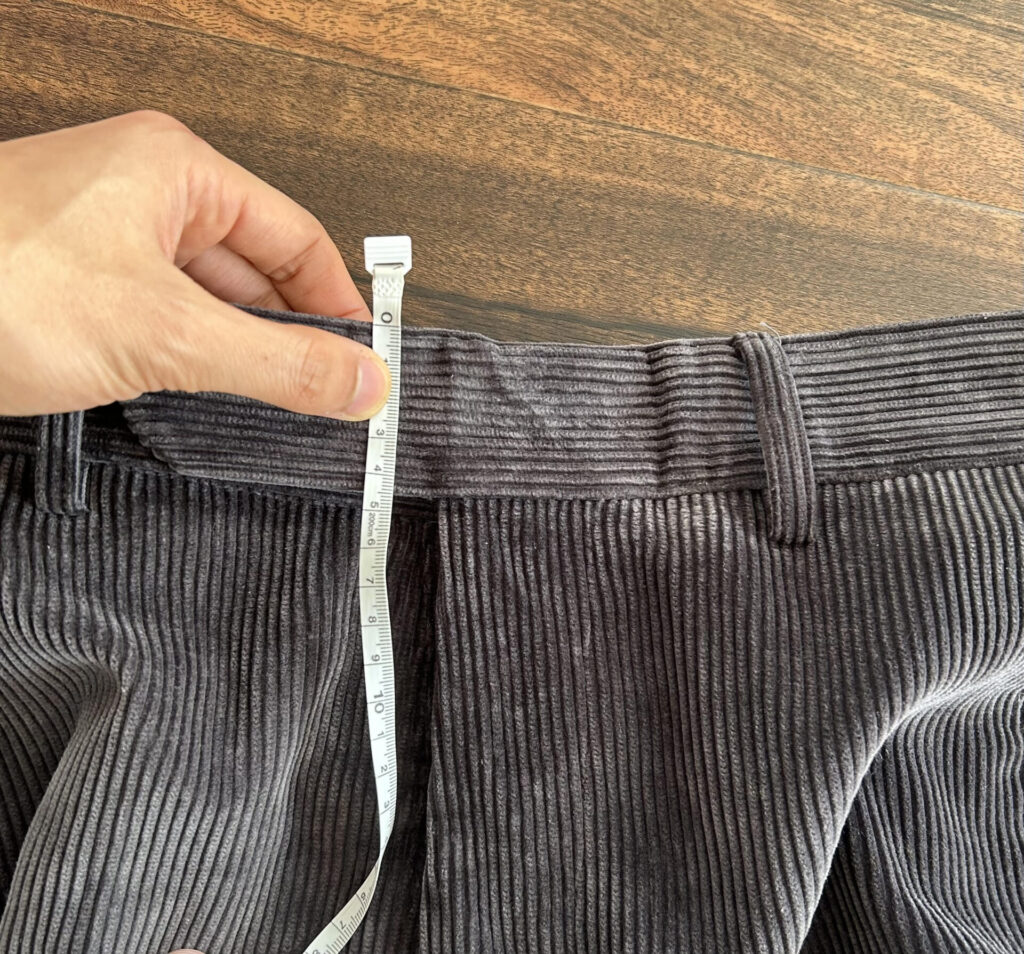
I would say the average waistband width on men’s trousers is around 3.5–4.0 cm (1.38–1.57 in).
A wide waistband can cause an issue when you wear a belt.
If the belt is too narrow compared with the waistband, the waistband can become visible above and below the belt.
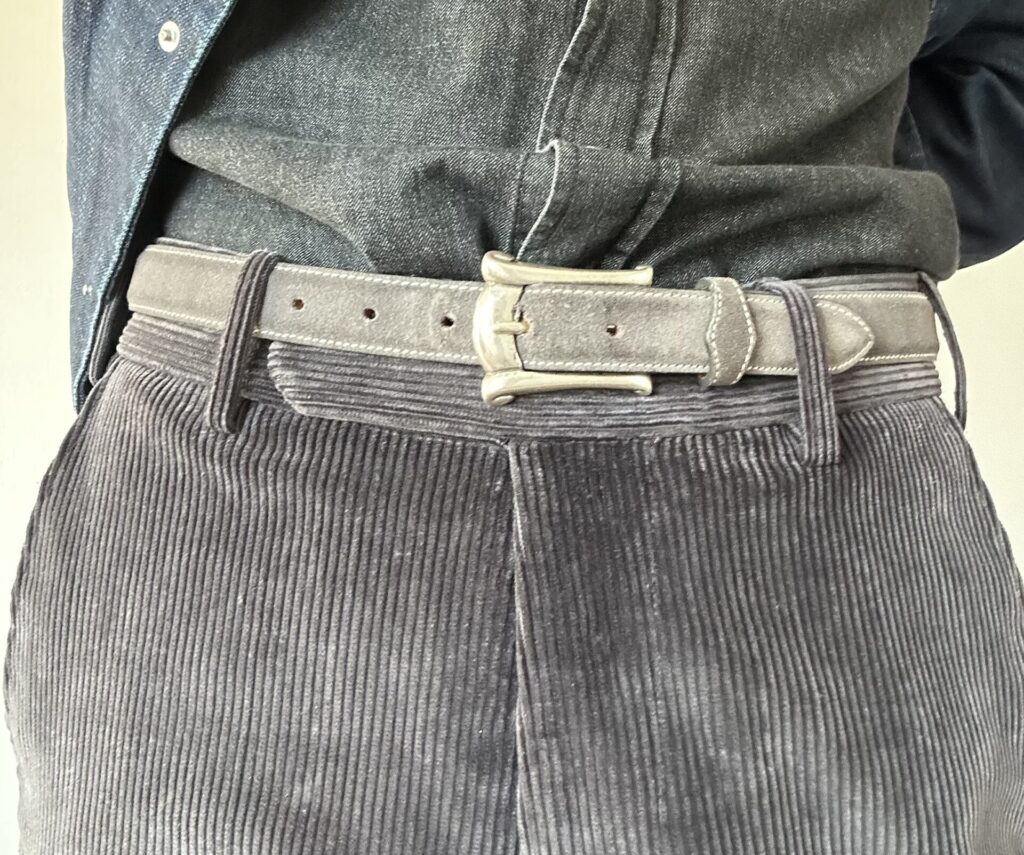
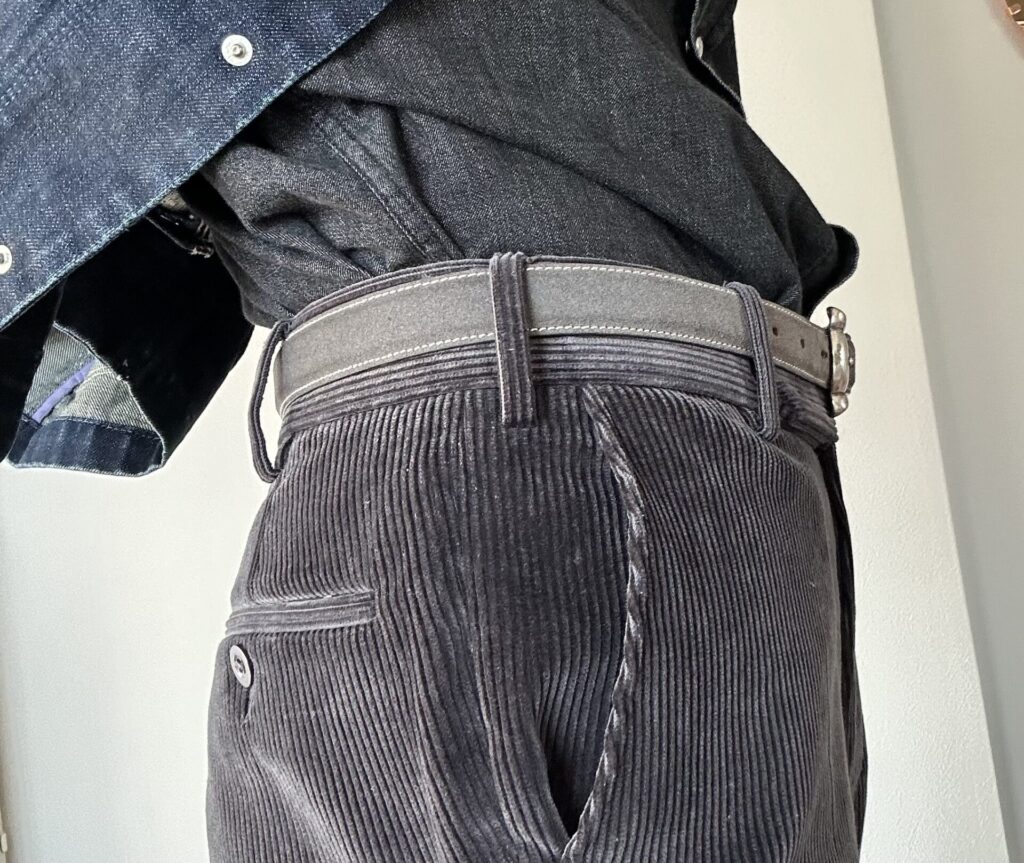
I think it looks best when the belt is close in width to the waistband. But in this case, that would mean wearing a 4.5 cm (1.77 in) belt, which is quite wide and gives the trousers a more rugged, American casual look.
The only solution I can think of is to position the belt as close to the center of the waistband as possible so that the excess fabric is less noticeable. However, the belt tends to move upward on its own, so constantly worrying about its position is stressful.
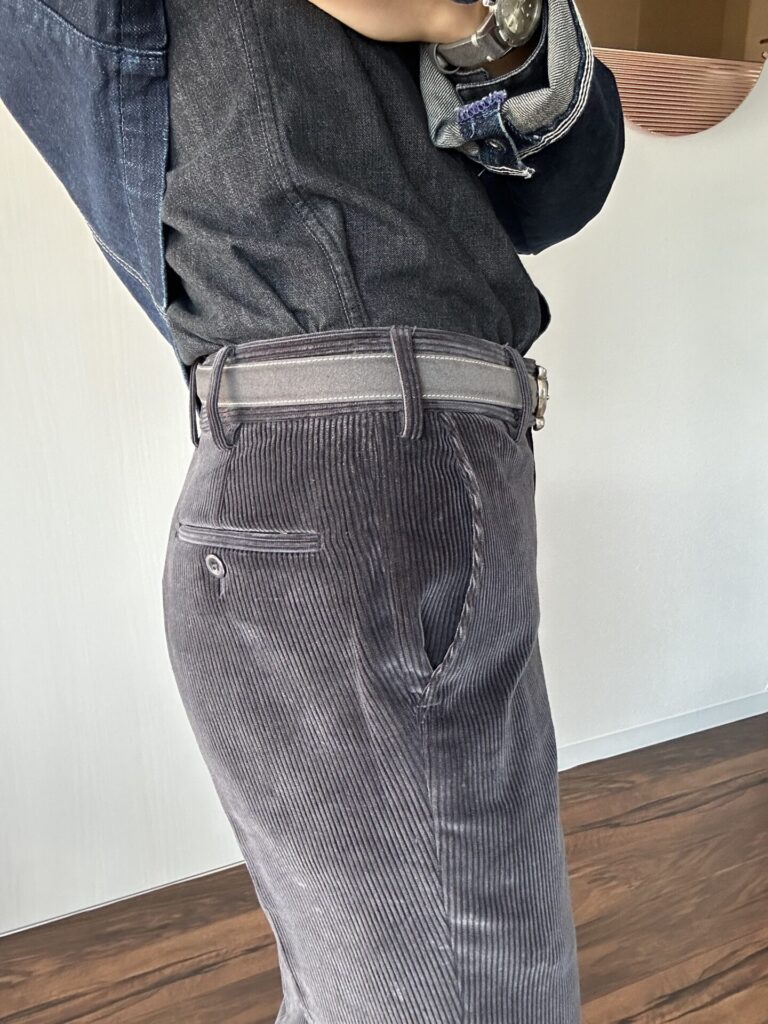
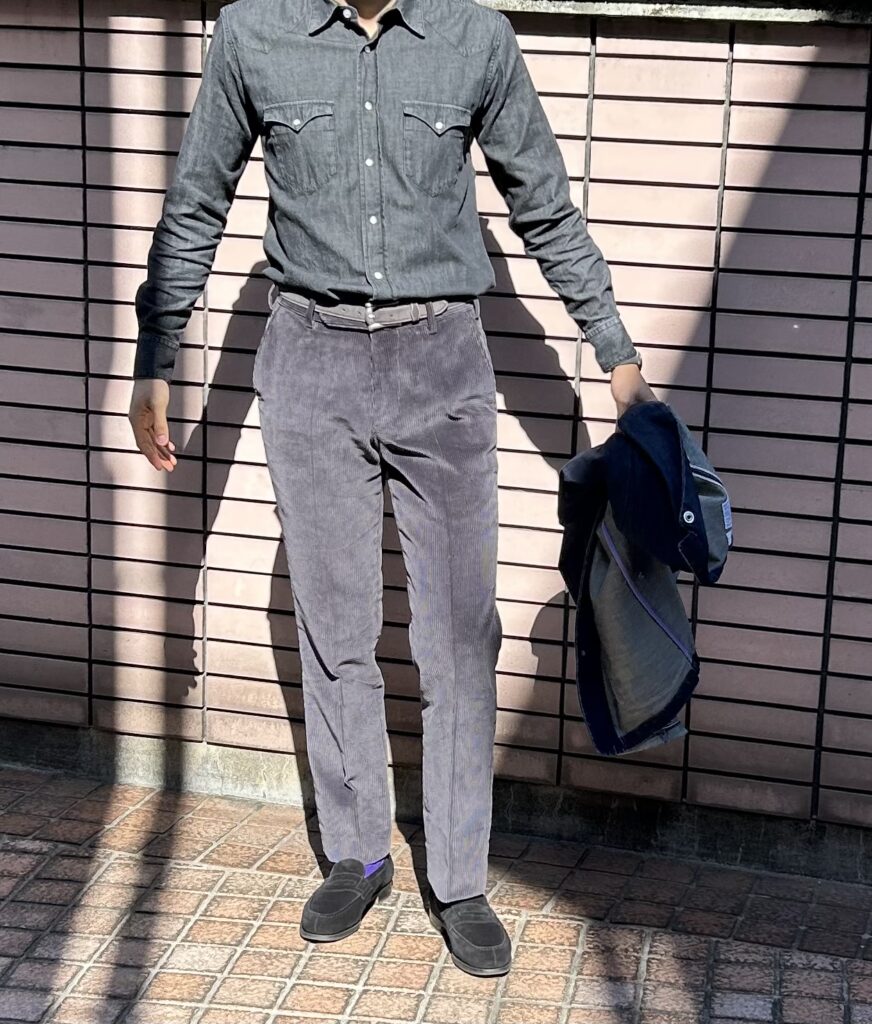
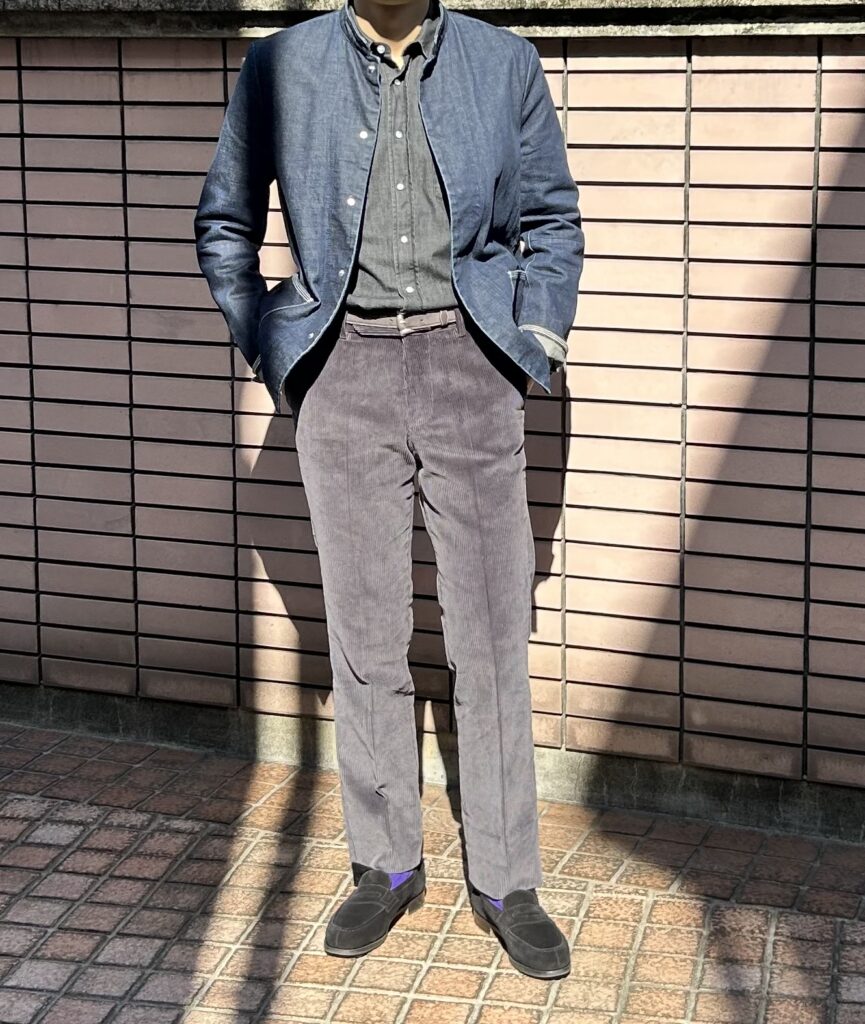
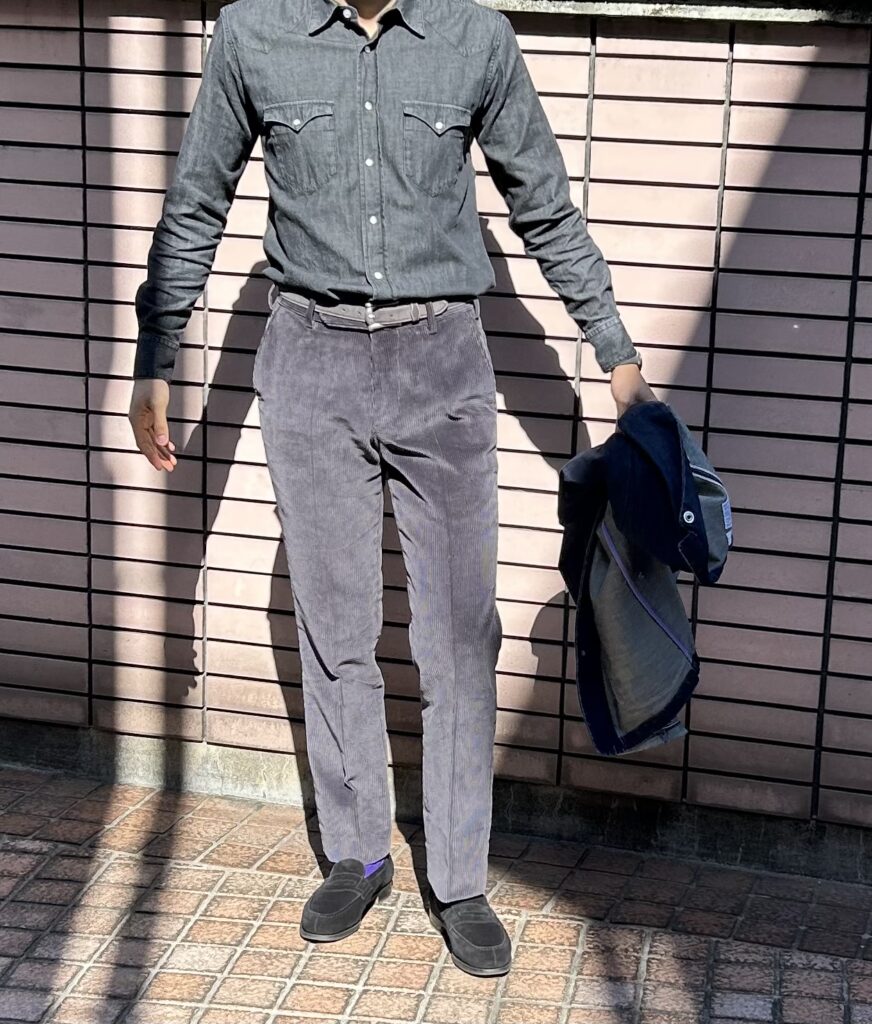
As you can see in this photo, letting the shirt blouse slightly over the waistband makes the issue less noticeable. But for someone as particular as I am, I cannot help noticing when the waistband sticks out.
With that in mind, the beltless side-adjuster version might actually be the better choice.
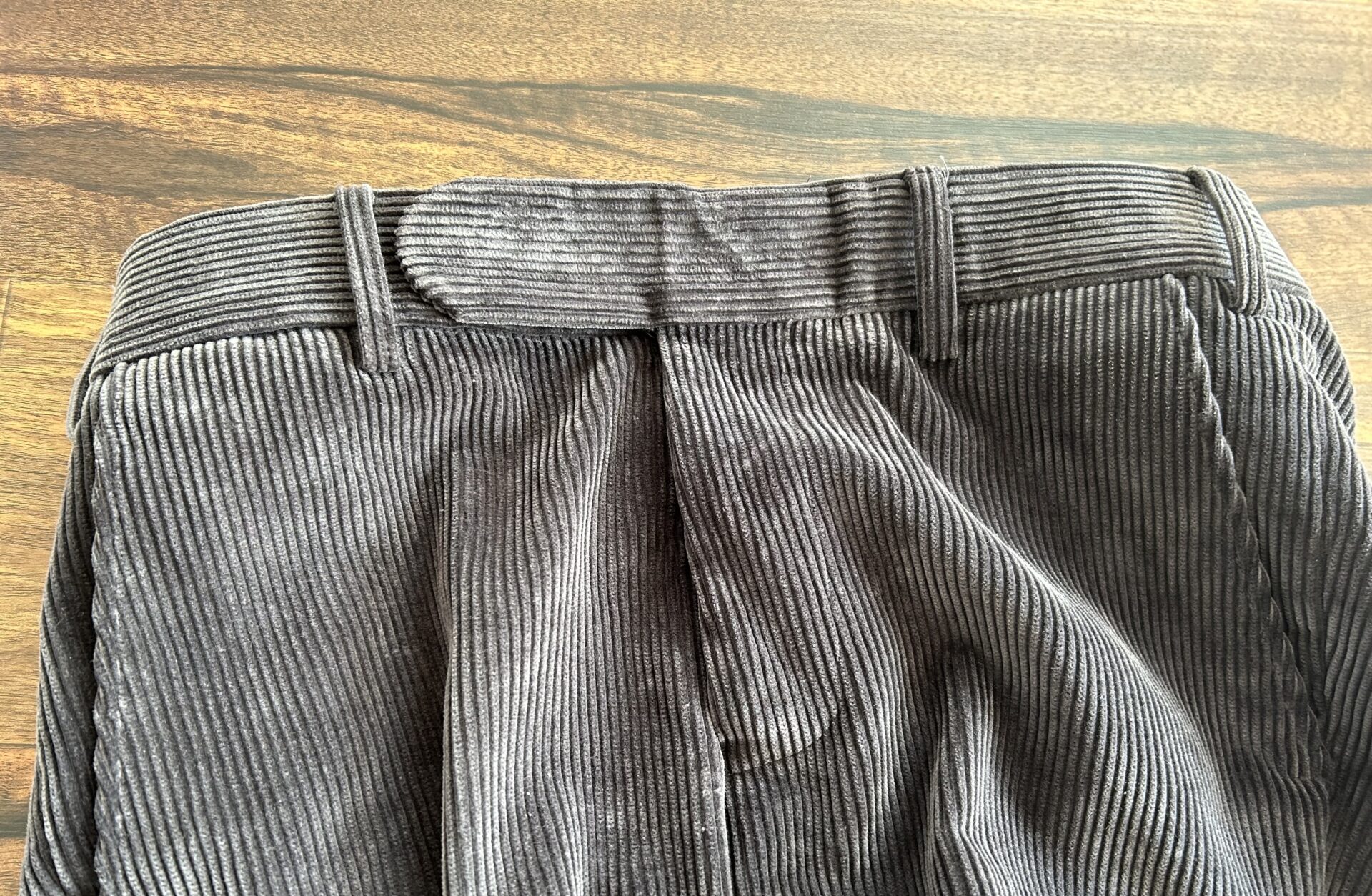
A Relatively Long Waistband Extension
There is a small extension above the waistband, sometimes called a waistband extension or extended tab. It is not necessary for the trousers to function, but CORDINGS uses a relatively long one.
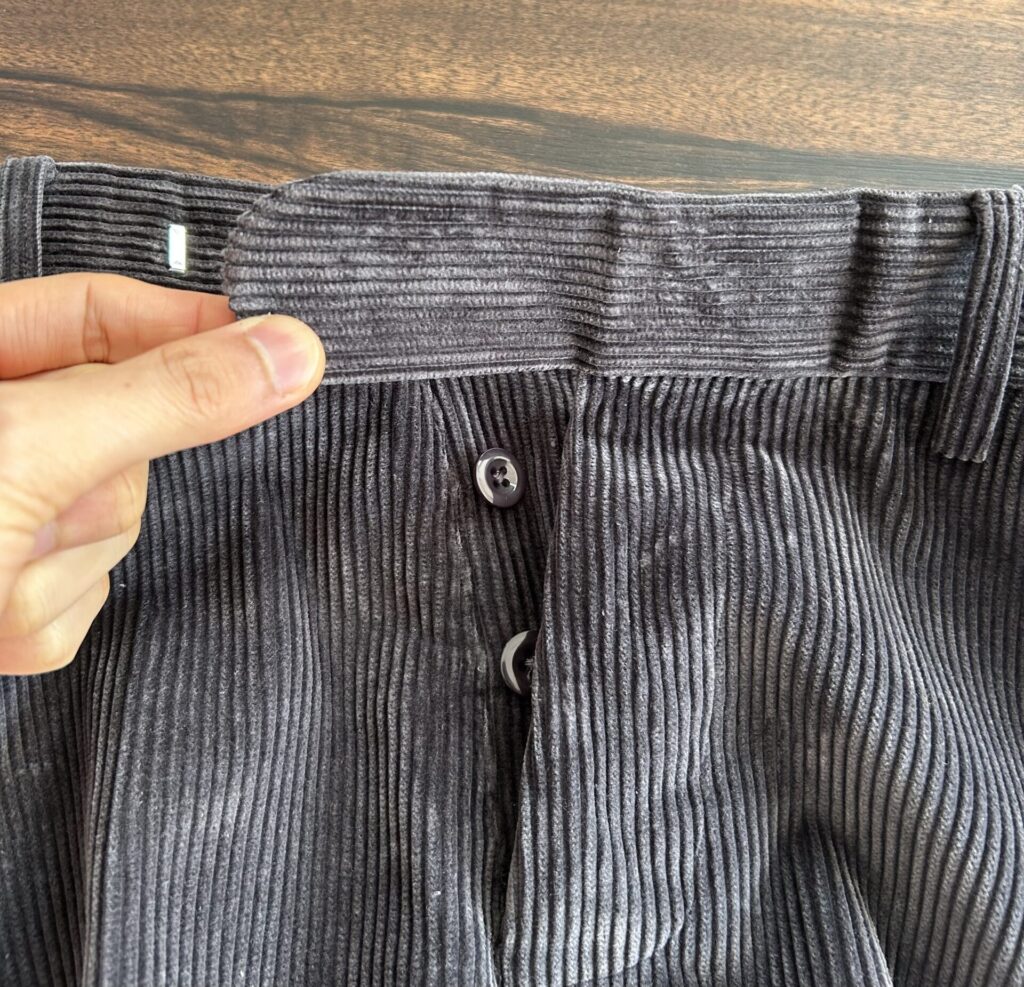
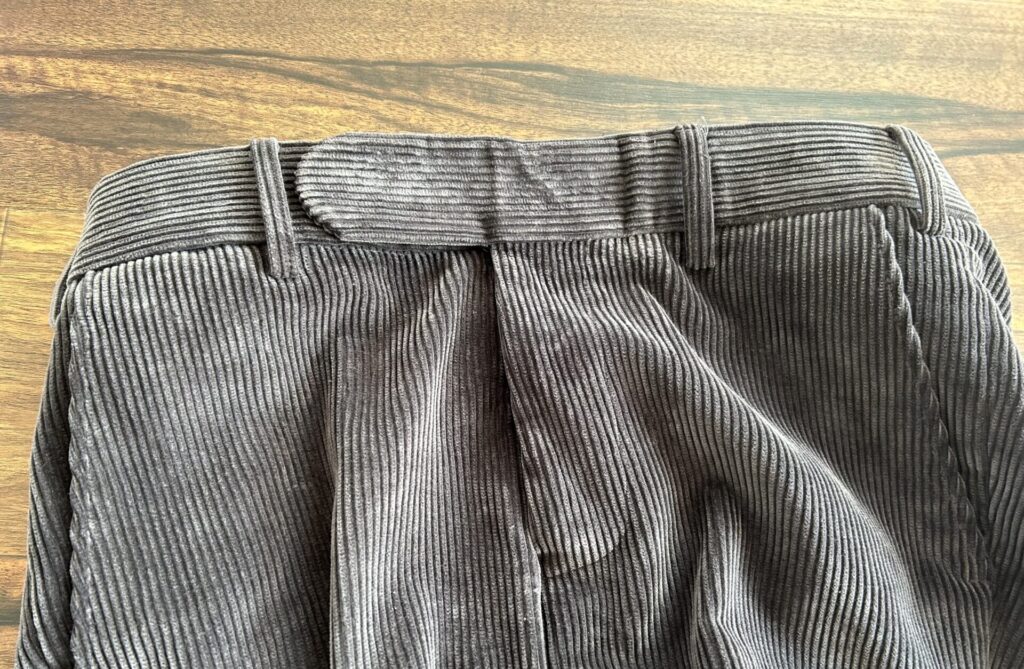
When wearing the trousers with suspenders instead of a belt, I think this extension looks good. But if you always wear a belt, it can actually get in the way.
For the same reason mentioned above, if your belt is too narrow, you can see the extra fabric of the extension behind it, making the waist area look a little cluttered.
No Pleats
CORDINGS’ corduroy trousers are basically offered in a flat-front, no-pleat style.
There is a BEAMS F exclusive version with double forward pleats, but that is an exception made specifically for that collaboration.
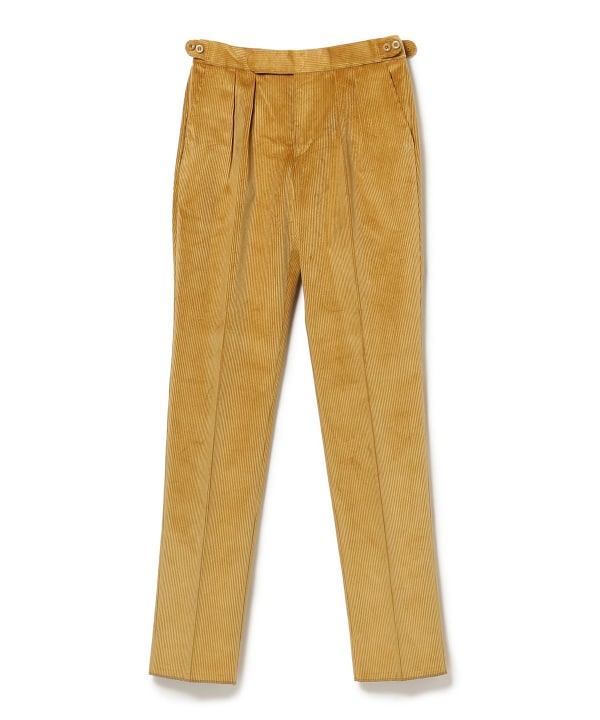
This is ultimately a matter of taste, but wide-wale corduroy already has a strong country character and can look somewhat rugged or rustic. By keeping the trousers flat-fronted, there is a slightly sportier feel that helps reduce that heaviness. For that reason, I actually think the no-pleat design works well.
The pair I bought is gray and has no pleats, so the country character is relatively understated.
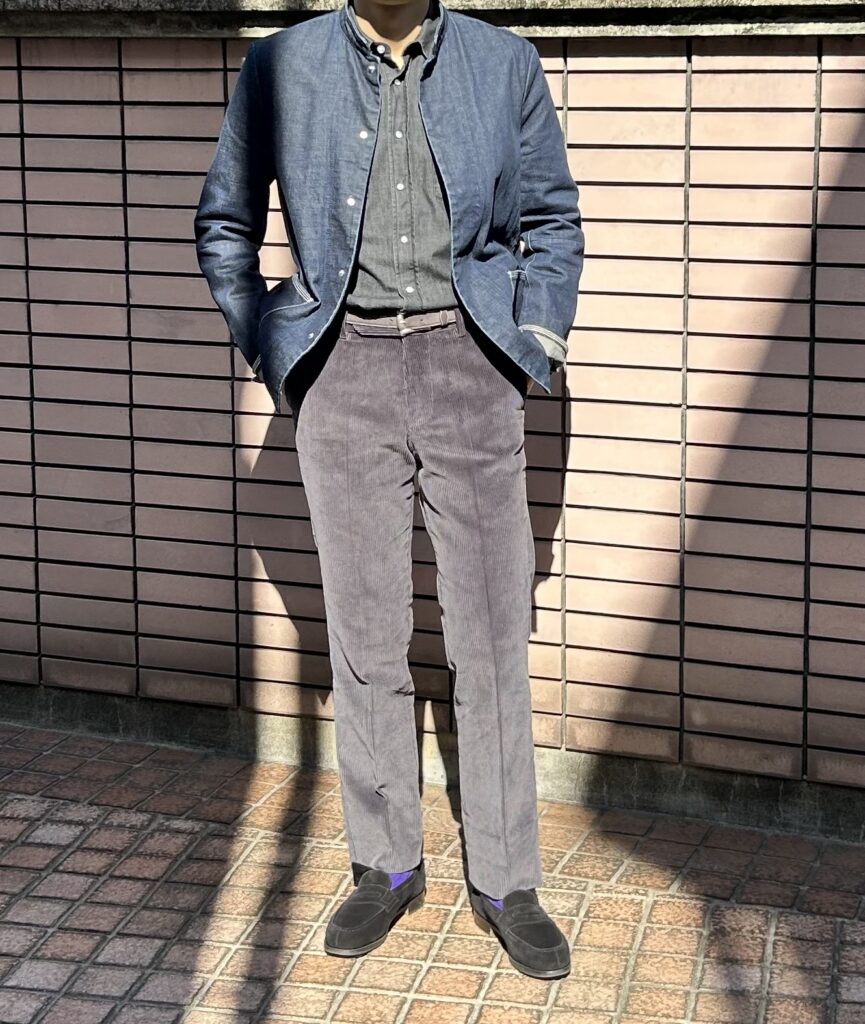
I like both styles, though.
Made in Portugal
CORDINGS is a British brand, but many of its current products appear to be made in Portugal or Morocco rather than in the UK.
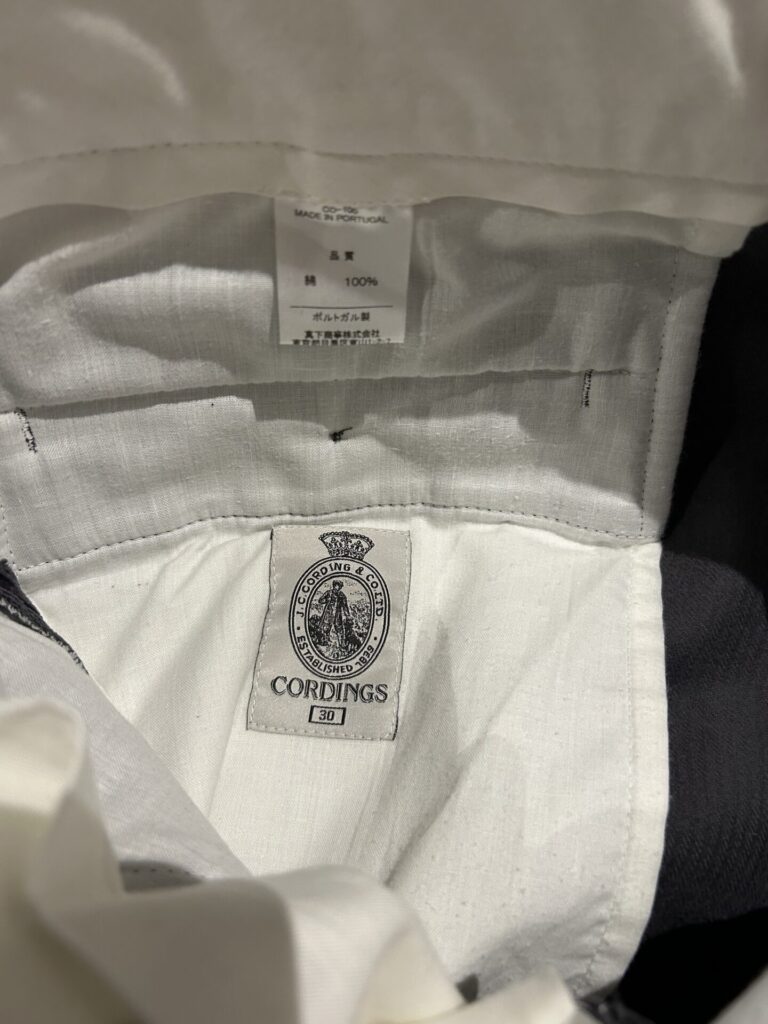
I am the kind of person who gets a little carried away by the idea that “Made in England = better,” so when a pair of ready-to-wear trousers costs nearly $270, I honestly wish they were made in England.
That said, the construction is more than good enough, so I cannot really complain.
Single or Cuffed Hem?
The trousers have an inseam of more than 90 cm (35.43 in), so unless you have particularly long legs, there is enough length to finish them with either a plain hem or cuffs.
It is simply a matter of preference—there is no objectively correct choice—but I chose a plain hem.
For the same reason as with the pleats, I felt that wide-wale corduroy already has a somewhat rugged, substantial character, so a plain hem makes the trousers feel lighter, more urban, and easier to wear.
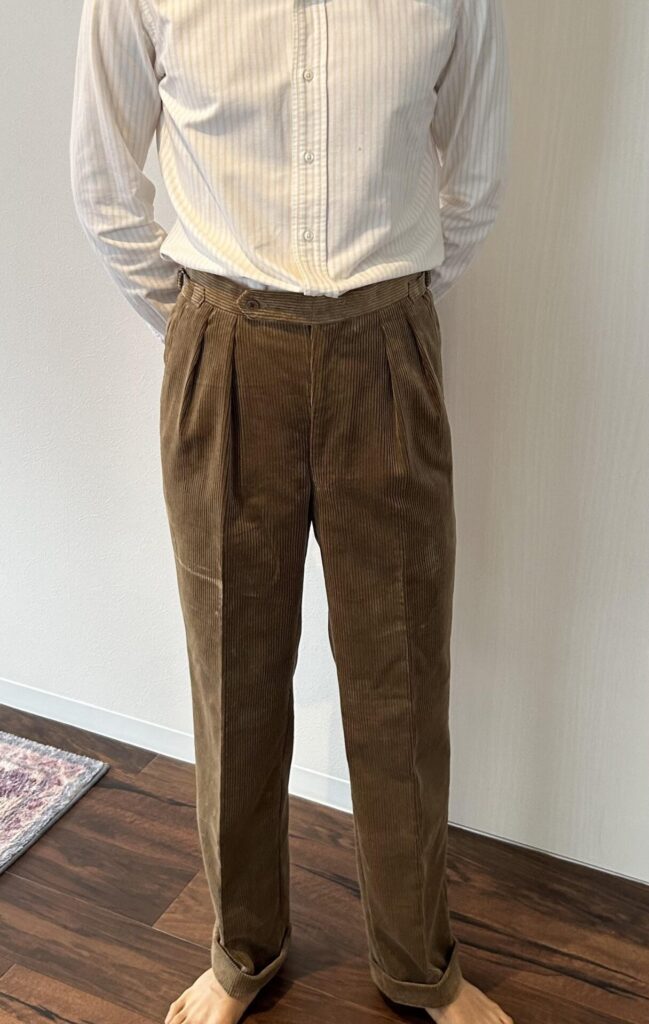
There is also the fact that the trousers are flat-fronted. I felt that a flat-front design combined with cuffs would make the upper half feel light and the lower half heavy, creating an imbalance. If you are going for cuffs, I think it would look better with pleats as in the example below.
The Waist Runs Large
The sizes are labeled by waist measurement in inches: 28, 30, 32, 34, 36, and 38. However, if you look closely at the actual measurements, they are about 2.3 cm (0.91 in) larger than the stated inch size, so this is something to be aware of when choosing your size.
One inch is 2.54 cm, so:
28 inches = 71.12 cm (28.00 in)
30 inches = 76.2 cm (30.00 in)
32 inches = 81.28 cm (32.00 in)
should theoretically correspond to these measurements, but instead:
28 inches = 74 cm (29.13 in)
30 inches = 78 cm (30.71 in)
32 inches = 84 cm (33.07 in)
are the actual measurements.
I wear the 30-inch size myself, and the waist is indeed around 78 cm (30.71 in), so I believe the centimeter measurements are the more reliable guide.
Only One Back Pocket
There is only one back pocket, on the right side.
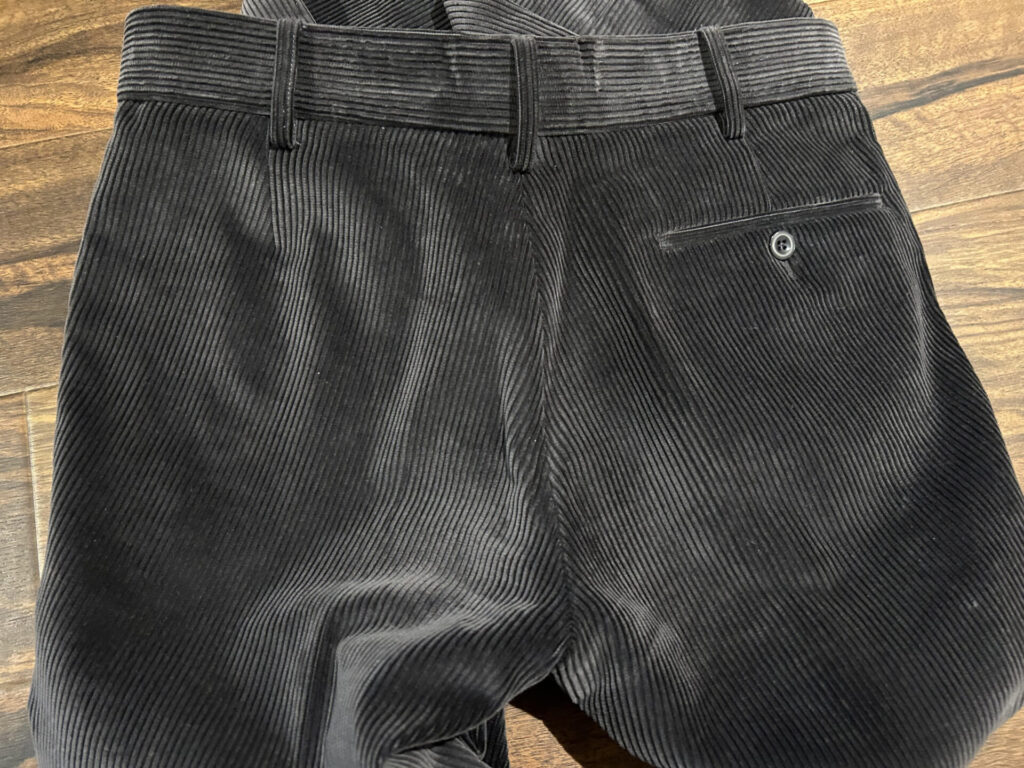
Part of me feels that this ignores left-handed people, but for a right-handed person, the right pocket is the one you are most likely to use anyway, so one pocket is probably enough.
I actually like the clean and decisive look of having no left back pocket. Some people may dislike it because it makes the shape of the seat look more exposed, but if you like this kind of design, it is a nice feature.
Finally: The Color I Recommend
Beige, tan, brown, black, gray, navy, blue, moss green, and white.
Every color offered by MASHIMO & CO looks great, and I could honestly be tempted to own all of them. But at the moment, I was most drawn to gray, so that is the color I chose.
It has a subtle hint of purple, giving it a very elegant appearance with less of the traditional country feel associated with corduroy.
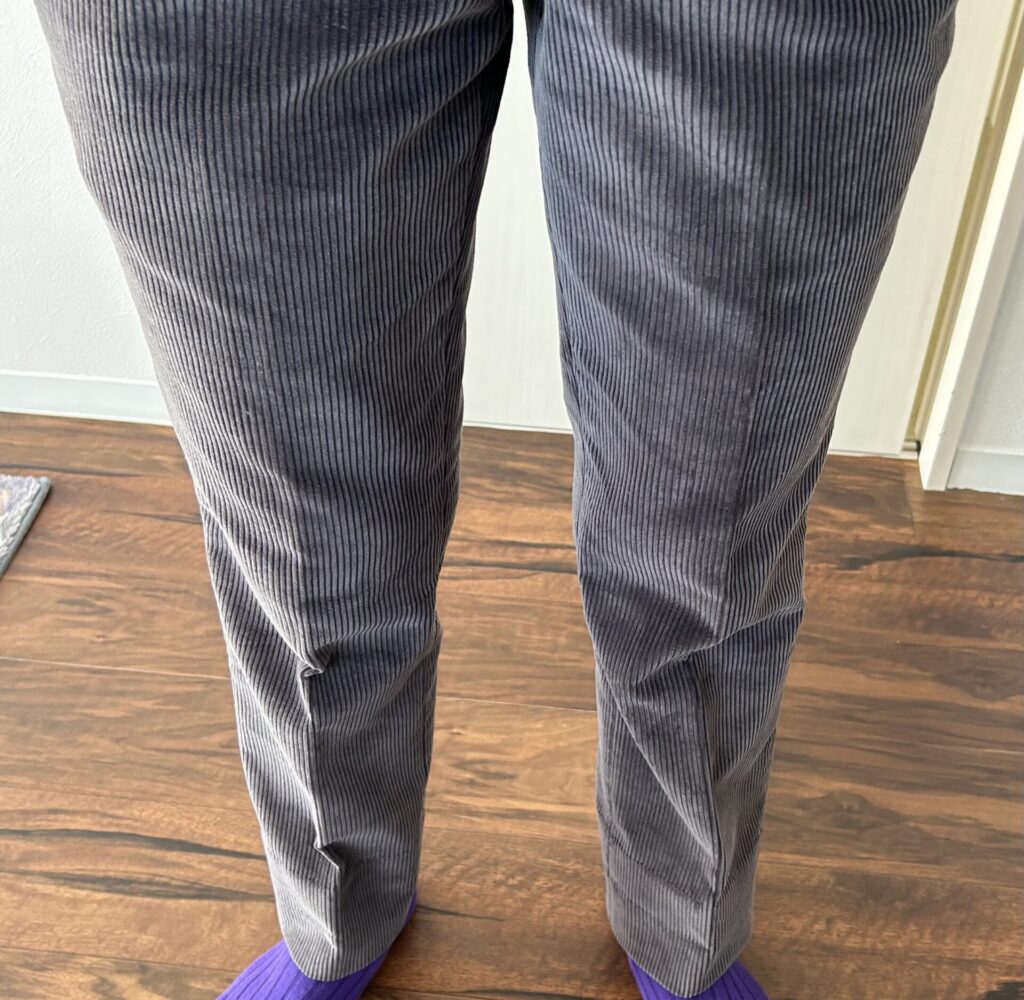
Beige and brown—the quintessential corduroy colors—are available from many other brands and can also be found easily in vintage clothing. Gray corduroy, however, is relatively unusual, and that is one of the things that makes this CORDINGS color particularly appealing to me.
Incidentally, on the British CORDINGS website, this color is not called Gray but “Smoke.” Somehow, doesn’t “Smoke” make the color sound even more appealing?
I am looking forward to seeing what colors they release next season.
That’s all for today.
Thank you for reading.

コメント