Hello, I’m Mr. Linen.
What kind of tie do you wear for formal occasions such as weddings?
In Japan, this kind of style (black suit with white or silver tie) is widely worn, but it is far from standard in Europe, the home of classic tailoring.

“A classic dark suit, a white or light blue wide-spread shirt, black cap-toe shoes, and a navy tie with white pin dots—this combination will work at any formal event anywhere in the world.”
This was stated by the late Masakatsu Ochiai, a true master of classic menswear.
So, what about regimental stripe ties?
In this article, I will explore how appropriate regimental stripe ties are for formal occasions.
What Are Regimental Stripes?
The terms “regimental” and “striped” are often confused, which makes things a bit complicated.
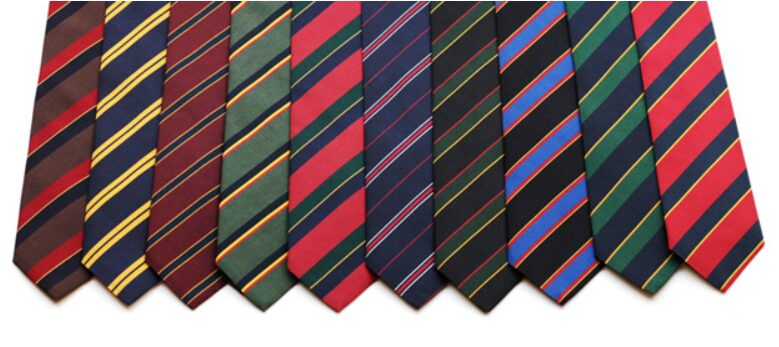
You may also hear the term “regimental stripe” used as a single phrase.
Strictly speaking, regimental stripes are defined as evenly spaced, relatively wide stripes in two or more colors. However, for the sake of this article, I will refer to all diagonal striped ties as regimental.
Regimental stripes range from very fine lines—like those seen on striped shirts—to bold designs with only a few wide stripes that can be as much as 10 cm (about 3.9 inches) across.
They are often categorized as narrow or wide depending on stripe width, but there is no strict measurement that defines this—it’s largely subjective.
Originally, regimental ties came from the United Kingdom. Universities, military regiments, police units, and sports clubs each created their own unique color combinations and stripe patterns. These ties were then given to members as part of their uniform, symbolizing affiliation with a specific group.
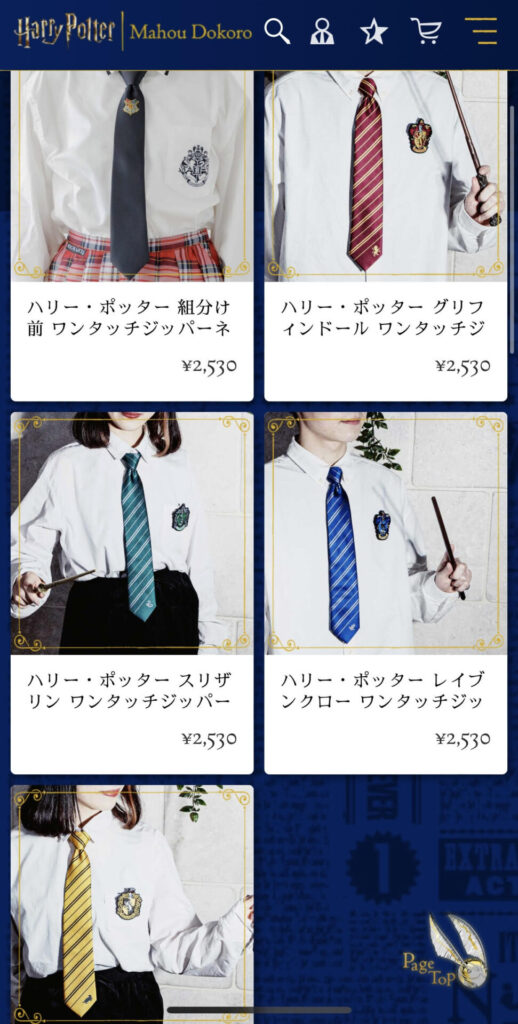
A good example can be seen in Harry Potter—each house (Gryffindor, Slytherin, Ravenclaw, Hufflepuff) has ties with the same pattern but different colors.
Regimental Ties Cannot Be Truly Classic
“A regimental tie can only be considered truly classic when worn by a British person who belongs to that specific club, in the appropriate setting.
While regimental ties are historically authorized in Britain, their meaning is limited to representing and identifying a group. They do not fall into the category of modern classic style in a universal sense.
Even if others imitate this, it will never become a global standard. In formal settings, regimental ties are a privilege reserved for the British.”
This quote from Masakatsu Ochiai perfectly summarizes the issue.
For those of us who are not British—in fact, for anyone outside the UK—it can be said that wearing a regimental tie in formal settings is inappropriate and not truly “classic.”
Are All Regimental Ties Off-Limits?
However, if all regimental ties were completely off-limits, wouldn’t that be a bit of a problem?
Before learning this, I had already purchased many ties—nearly half of them are regimental. I certainly don’t want to throw them away.
It’s true that in international settings—especially in the UK—it may be safer to avoid regimental ties. However, such situations are relatively rare for most people.
Even in the UK today, relatively few people are deeply concerned with classic dress rules, and it’s likely that most people don’t pay much attention to the origins or strict etiquette of regimental ties. (This is just my assumption.)
So, in everyday life, I believe it’s perfectly fine to wear regimental ties without worrying too much.
Ochiai adds the following:
“This does not mean all regimental patterns should be rejected as classic. For example, former French President Jacques Chirac sometimes wore regimental ties with subtle colors and fine repeating patterns—these can be considered dressy ties.
The French generally prefer finer regimental patterns. However, I have never seen members of the British royal family wearing regimental ties in international settings.”

In Chirac’s case, I imagine that the tie was carefully chosen to ensure it did not replicate any specific British regimental pattern—whether by himself or a stylist, I don’t know.
Ochiai also mentions British royal dandies, but when looking at photos of King Charles, he seems to wear regimental ties quite frequently.


Whether he wears them when attending events related to specific affiliations, ensures they don’t represent any particular regiment, or simply doesn’t adhere strictly to such rules—I cannot say.
In summary, it seems that even in international contexts, regimental ties are not absolutely forbidden in every case.
Conclusion: Safer to Avoid in Formal Settings
As mentioned earlier, regimental ties are generally fine in Japan. However, for formal occasions, it is safest to avoid them.
You might not mind what people like me—who only have a surface-level understanding of classic rules—think. But depending on the audience, some may view it as inappropriate.
Embarrassingly, I once wore a regimental tie to a friend’s wedding without knowing any better.
I did at least choose one with bright, celebratory colors that I thought suited the occasion.

That said, the bigger issue is that I attended a wedding in a linen suit in the first place… not exactly the most conventional choice.
As for linen suits, I have a personal mission to promote them more widely in Japan—so I’ll probably continue wearing them even to weddings.
Related article:


However, when it comes to regimental ties, I will avoid them in formal situations going forward.
I’ll also make sure not to bring them when traveling to the UK.
In everyday life in Japan, though, I plan to keep wearing them freely.
I hope you found this helpful.



コメント