
I run a blog with the rather silly name “Mr. Linen,” but I am completely serious about my love for linen.
The advantages of linen as a material are well known: it absorbs sweat easily, dries quickly, does not cling to the skin when wet, has natural deodorizing properties, is easy to wash, becomes denser and stronger the more you wash it, allows air to pass through while still offering insulation, and wrinkles are simply part of its nature (so you don’t need to worry about them).
I believe most people are already aware of these qualities.
Linen is widely used not only for clothing, but also for bedding and kitchen textiles, so it is by no means a rare material. In fact, long before cotton became common, linen had already been supporting everyday life for centuries.
But what about linen suits?
How many people around you regularly wear a linen suit?
In Europe, linen suits are said to be relatively common, and wearing one in a business setting during summer is generally considered acceptable.
In Japan, however, linen suits are still strongly associated with casual wear. (A white three-piece linen suit might be formal enough for a wedding, but realistically, only someone with exceptional style could pull that off.)

In this article, as someone who truly loves linen suits, I am going to strongly (perhaps excessively) promote their appeal to those who have not yet discovered it. If even one more person finishes this article thinking, “Maybe a linen suit is actually great,” I’ll be very happy.
Wrinkles Are What Make Them Elegant
The main reason linen suits are considered casual is not just the thickness of the yarn, but above all, the wrinkles.
In Japan especially, wrinkles are still widely associated with a lack of elegance.
Of course, wearing a wrinkled suit or shirt simply because you skipped ironing is not elegant.
That just makes you look sloppy.
However, with a linen suit, wrinkles that form naturally at the underarms, elbows, knees, and back somehow appear elegant.
The sight of a linen suit etched with these wrinkles feels irresistibly beautiful to me.
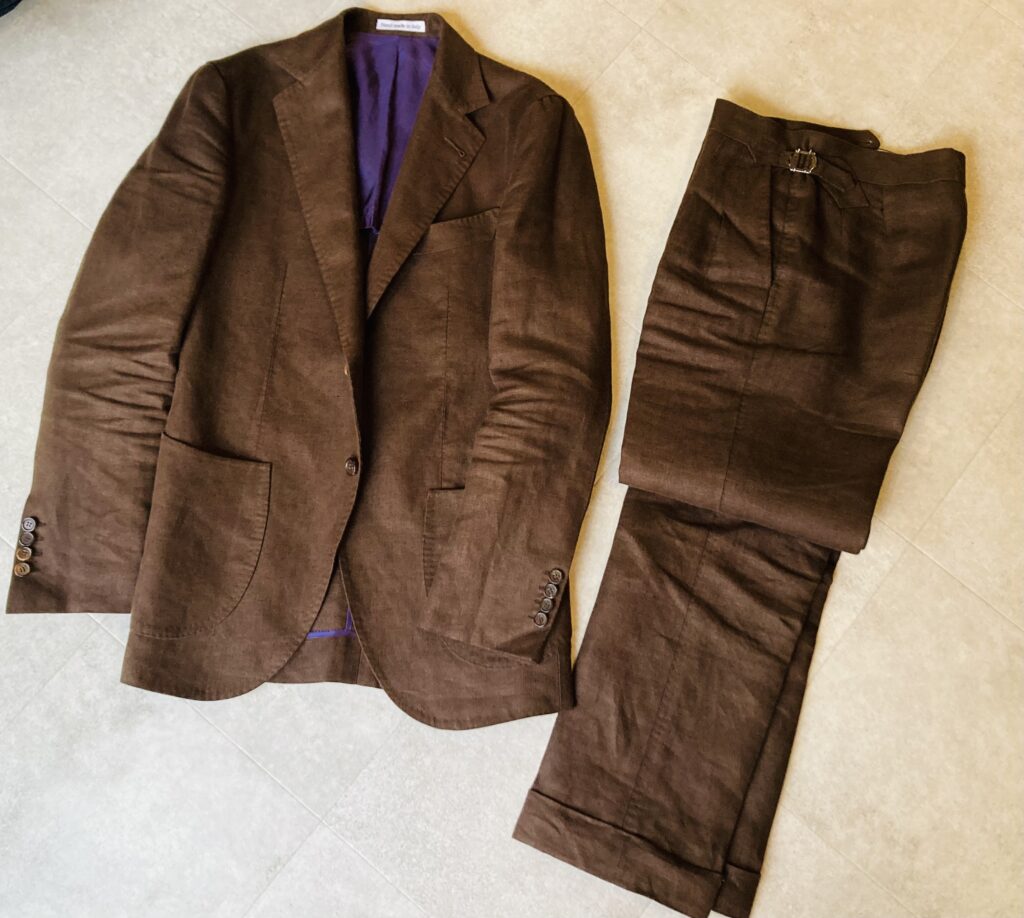
I honestly don’t know why. I like it because I like it—there’s nothing more to explain.
Even with wool suits, wrinkles that form naturally through wear don’t necessarily look sloppy, but generally speaking, fewer wrinkles are considered more elegant. Linen is the rare exception.
In other words, linen suits are the material where wrinkles are most forgiven—and even appreciated.
That said, does this mean you don’t need to iron at all? Half yes, half no.
Just like any other suit, I recommend properly pressing the trousers before wearing them, and lightly ironing or steaming the jacket to minimize wrinkles.
Still, wrinkles will inevitably form, so there’s no need to be overly obsessive. A light touch is more than enough.
This easygoing nature is a major advantage.
The Raw Texture of the Fabric
The second appeal of linen suits: their texture.
This applies not only to suits, but to all linen garments. Linen has a truly unique surface character.
Fresco, flannel, tweed, cashmere, silk, mohair, corduroy, seersucker, solaro, denim, twill—there are countless types of fabrics in menswear.
Each has its own beauty, but linen stands out for its coarse, rugged texture.
Put simply, the yarn is thick and the weave is open.
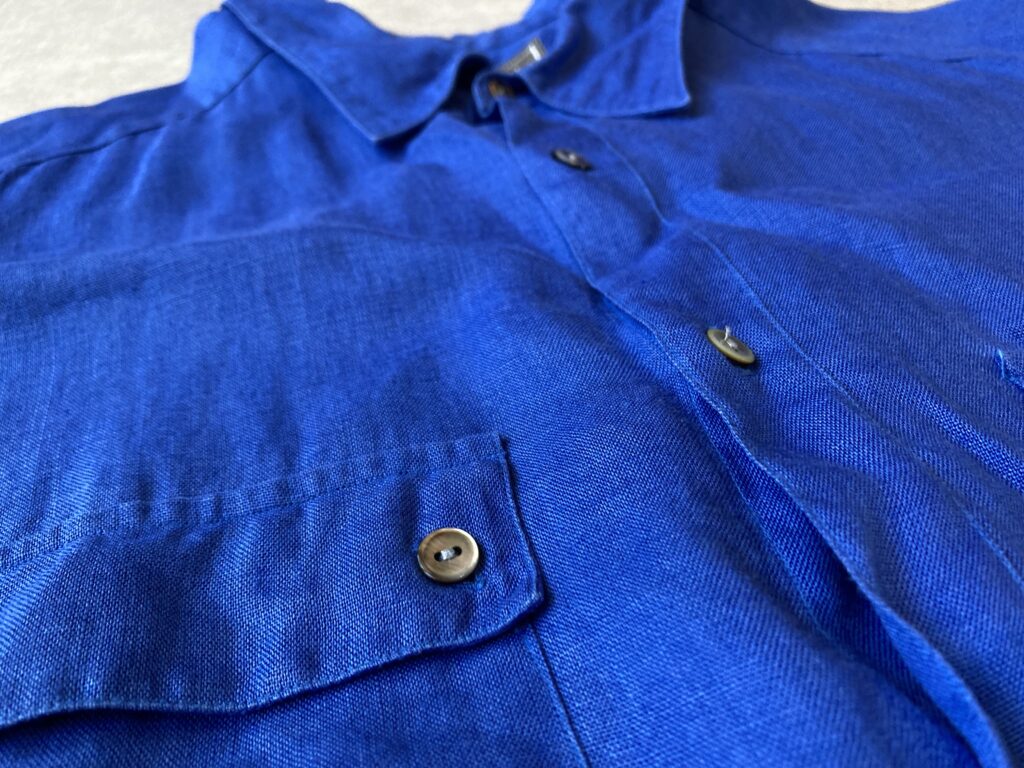
This structure provides breathability and prevents the fabric from sticking to the skin, but what I want to highlight here is the visual effect.
Because it isn’t smooth, linen looks casual. Yet because it has a subtle, natural sheen, it also feels elegant. These two seemingly opposite qualities coexist.
A clear example is a black shirt.
A black shirt made from cotton or silk can easily look overly glossy and sensual—something only rock stars or fashion icons can pull off convincingly.
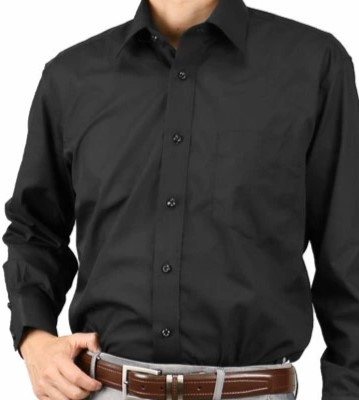
But make the same black shirt in linen, and while it retains a touch of sex appeal, the excessive shine is softened, making it wearable for ordinary people.
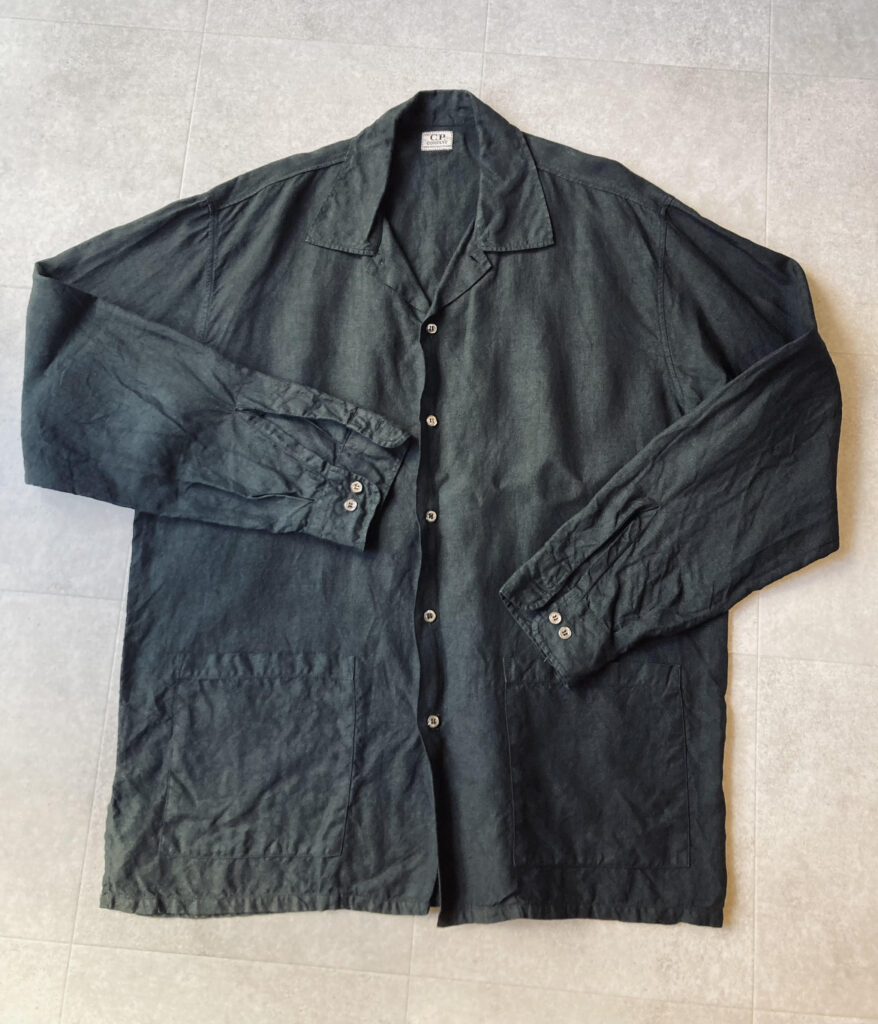
Add wrinkles to that, and it becomes even more natural.
One last thing: linen fabric actually trembles slightly when you shake it. If you own a linen garment, try holding it and gently shaking it.
If you ask, “So what?” I can’t really argue—but am I the only one who finds that subtle movement beautiful?
Built to Be Worn Hard
The third appeal of linen suits.
Durability.
Compared to wool suits, linen suits are significantly tougher.
The thick yarn makes them resistant to abrasion and tearing, resulting in a long lifespan.
The more you wear them, the softer they become, the more natural wrinkles they develop, and the more character they gain.
If you appreciate the aging of leather or denim, you will likely enjoy how a linen suit ages as well.
With overly delicate fabrics, you start to feel that every wear shortens the garment’s life.
When that happens, you save it only for special occasions.
Linen and denim are different. You can wear them endlessly, and they only get better.
When choosing clothes from your closet, aren’t those the pieces you instinctively reach for?
Easy to Wash
The fourth appeal of linen suits.
Related to their durability, linen suits are relatively easy to clean.
That said, throwing them into a washing machine is risky. Especially with jackets, the internal structure can be damaged even if the fabric itself survives.
I personally don’t have the courage to machine-wash a linen suit.
However, gentle hand-washing with water is completely possible.
Dry cleaning is an option, but it mainly removes oil-based stains, not water-based ones like sweat, and the chemicals can be harsh on the fabric.
After learning that, I stopped using dry cleaning altogether—even for wool, including thick flannel. I hand-wash everything at home.


There are professional cleaners that specialize in water washing, but they are expensive.
For a full suit, prices start at around USD 100, so for me, that’s a once-every-few-years option.
Water-wash specialty cleaner (Japanese site)
Realistically, after regular wear, steaming the garment inside out to kill bacteria, spot-cleaning, hand-washing trousers once a year, and either carefully hand-washing or outsourcing the jacket seems to be the best approach.

In any case, compared to wool, linen is far easier to maintain.
If you spill wine, spot-washing with water is relatively simple.
Surprisingly, Not That Cool
Linen is known for being cool and breathable.
This is true—but there’s a catch.
A truly elegant linen suit requires a certain fabric weight.
If the fabric is too light, the wrinkles become too fine, creating a flimsy impression.
Heavier linen produces larger, bolder wrinkles that feel powerful and elegant.
Compare the wrinkles of a linen suit and a linen shirt in the photos below.

Which do you find more elegant?
In short, a great linen suit means heavier fabric.
And heavier fabric means more heat.
Lightweight wool fabrics like tropical wool or fresco are often cooler than heavy linen, while still maintaining elegance.
So wearing a truly elegant linen suit in summer in Japan is actually quite difficult.
Even with effort, around 30°C (86°F) is the upper limit. True comfort is closer to 27°C (81°F).
You either endure the heat for the sake of elegance, or accept that linen suits shine best outside peak summer.
About Linen Shirts
While suits benefit from heavier linen, shirts should be light. Thick shirts don’t tuck well and won’t work under jackets.
The coolness of a lightweight linen shirt is unmatched. Worn directly on bare skin, it can feel cooler than being shirtless.
As for the “see-through” issue: choose a shirt with chest pockets, wear an undershirt, or simply embrace it.
Personally, I wear an undershirt only with pure white linen shirts. Otherwise, I always wear linen shirts directly on my skin.
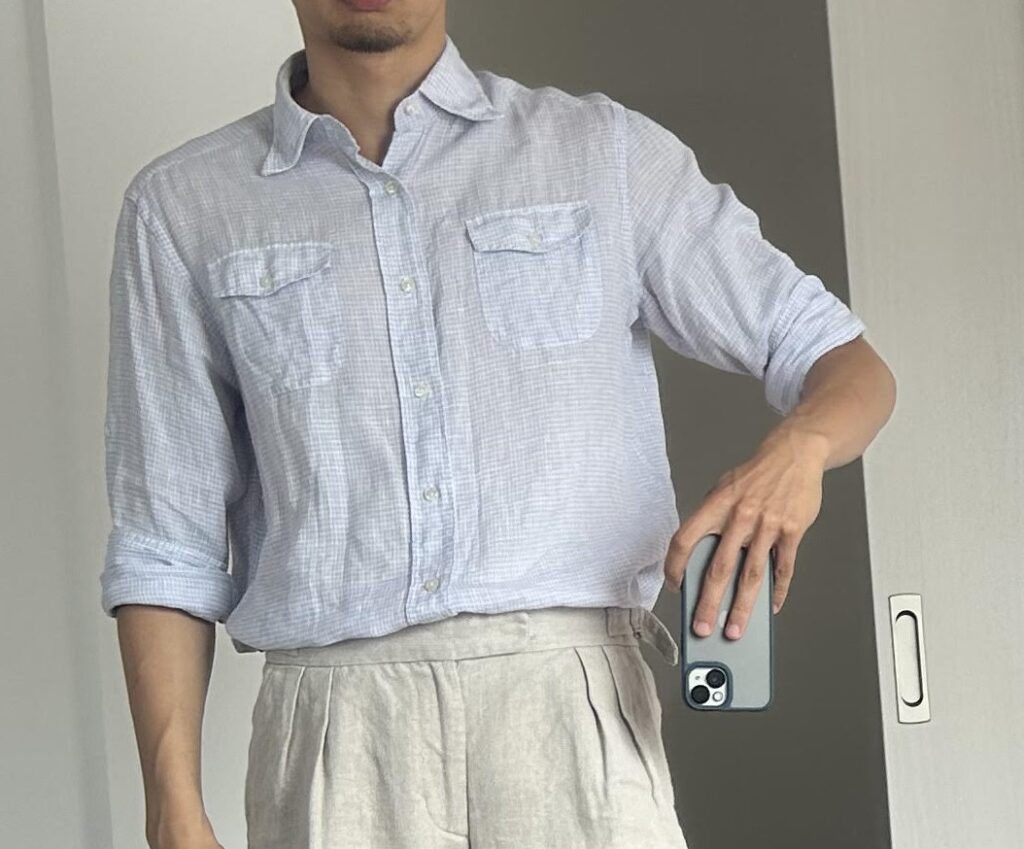
If you’ve never tried it, I highly recommend it.
Conclusion
I’ve laid out the functional pros and cons of linen suits, their visual beauty (entirely subjective), and poured out my love for them.
Do linen suits appeal to you even a little now?
If someone told me, “Money is no object—do whatever you want,” I think I’d open a shop dedicated entirely to linen suits.
Thank you for reading.


コメント