Hello. My name is Mr. Linen.
There are so many different types of shirt collars, aren’t there?
Which one is your favorite?
In this article, setting aside my personal preferences entirely, I would like to examine which collar style can truly be called the most classic.
目次
There Are Many Types of Collars
So, what kinds of collar styles actually exist?
There are simply too many to introduce them all here (and of course, I don’t claim to know every single one).
In Japan, commonly seen styles include spread, wide spread, semi-wide spread, cutaway, regular, button-down, tab, pinhole, round, wing, and one-piece collars.
Don’t Be Misled by Collar Names — What Matters Is the Angle
So then, which collar style is the most classic?
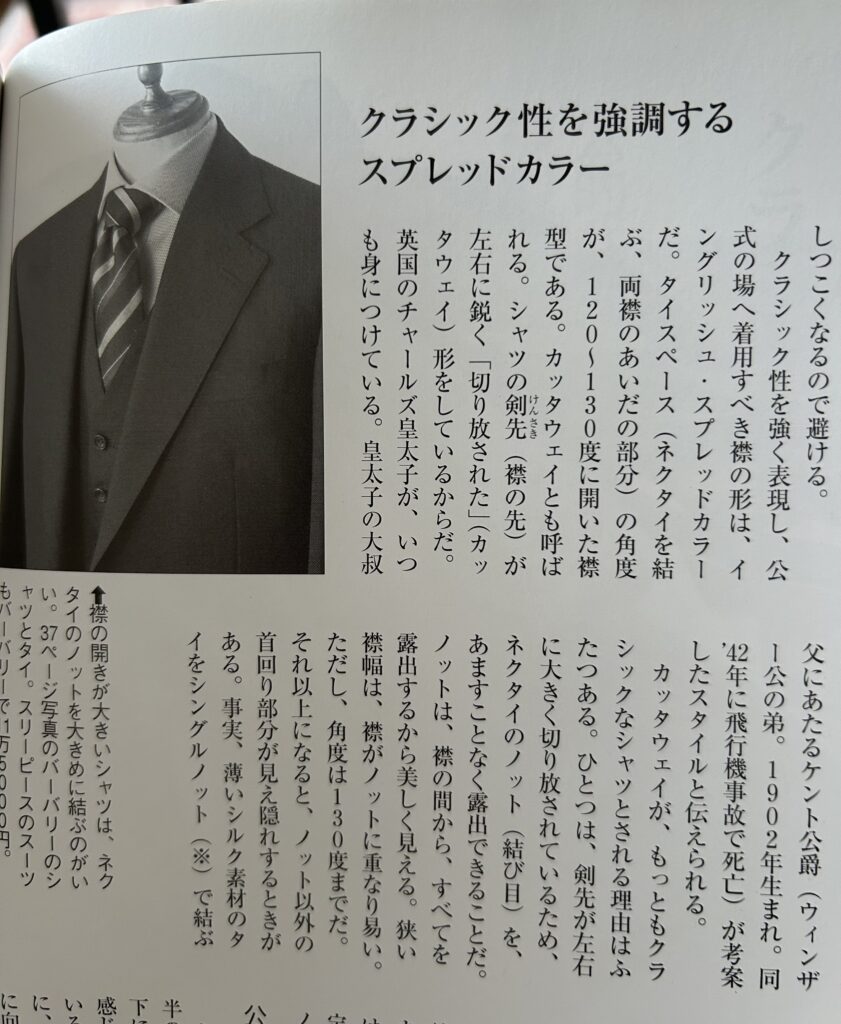
In the books I consider my textbooks, written by Masakatsu Ochiai (a Japanese classic menswear critic), it is stated that “for formal and public settings, the cutaway collar is appropriate.”

To me, the term “cutaway collar” had always meant a shirt with an excessively wide collar opening — something that became trendy years ago, but hardly something I would call classic.
So naturally, I was surprised.
However, upon carefully reading the book, I realized that what the critic refers to as a “cutaway” does not mean an overly open collar. Rather, he uses it as another name for what is generally called a spread collar.
The problem is that what a specific collar name refers to varies greatly depending on the brand or even the individual. Relying on names alone is therefore risky.
So what should we rely on instead? The answer is the collar opening angle, which I will explain in detail below.
Even among collars that include the word “spread,” such as wide spread or semi-wide spread, there are multiple variations.
These distinctions are purely based on how wide the collar opens. Wide spread, semi-wide spread, regular, and cutaway collars all share the same fundamental shape — only the angle differs.
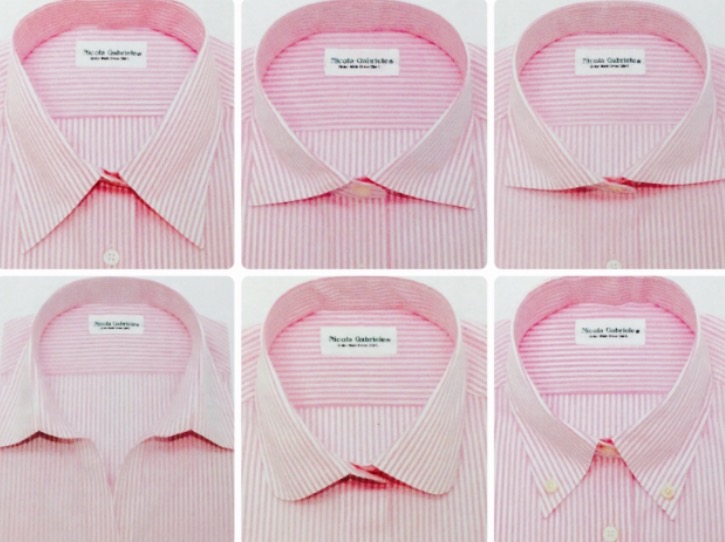
In this image, the top three collars share the same basic shape — only the angle differs.
On the other hand, button-down collars (with buttons), tab collars (with tabs), pinhole collars (with holes for collar pins), round collars, and wing collars differ fundamentally in construction. These can be considered variations or offshoots rather than the basic form. (In the image above, the bottom three fall into this category.)
As mentioned, the basic collar types (excluding these variations) are categorized by opening angle. However, as far as I have researched, there is no international standard that defines these angles numerically.
As a result, the same collar name may refer to angles that differ by dozens of degrees depending on the brand or person, or the same angle may be called by different names.
So when asked, “What is the most classic collar style?”
It is more accurate to answer in terms of angle rather than name.
So, What Is the Most Classic Angle?
Which brings us to the key question: what is the most classic collar opening angle?
To jump straight to the conclusion — it’s 138 degrees.
I collected photos of King Charles III and the Duke of Windsor, measured every collar angle, and found that 138 degrees appeared most frequently.
That was a lie.
There’s no way to arrive at such a precise answer.
Even if pinpoint accuracy is impossible, I would still like to narrow it down to a range of about 20 degrees.
In Ochiai’s book, the range given is 120–130 degrees.
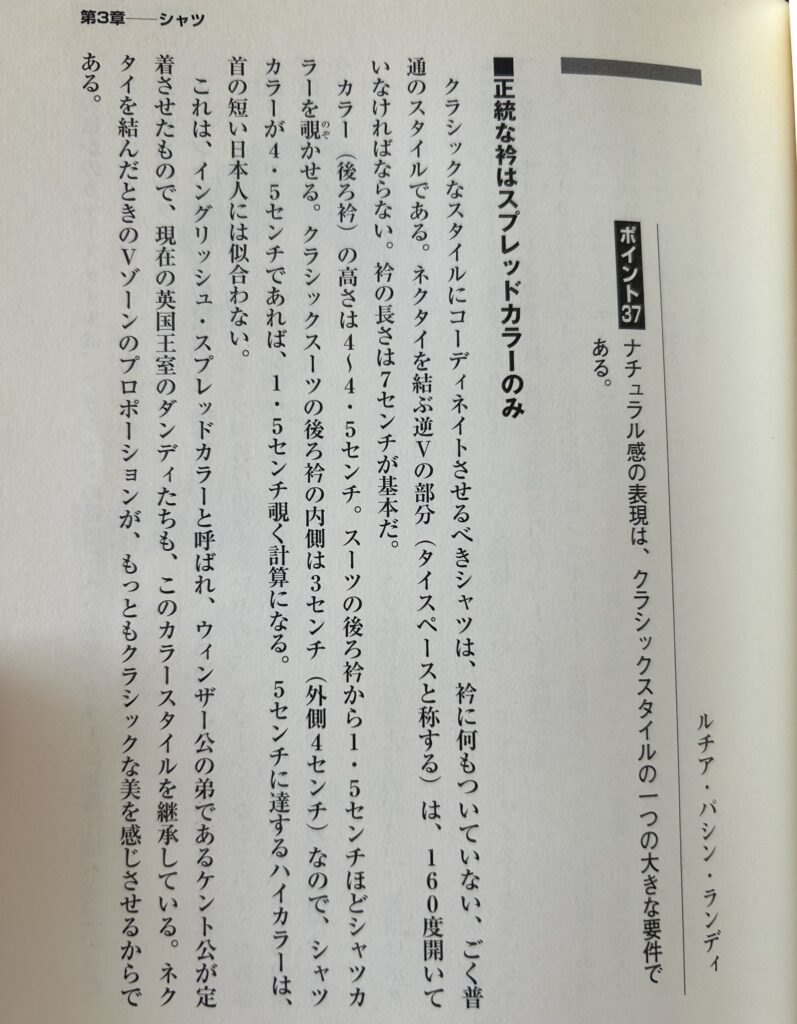
In another of his books, however, he specifies a precise 160 degrees.
In a column on the website of Atelier Bern, written by Haruto Takeuchi, another figure I also consider a reference point, the range given is 110–120 degrees.
If You’re Unsure About Shirt Collars (Japanese)
Personally, 160 degrees feels a bit too wide.
That said, after researching further, I found that King Charles III does indeed wear fairly open collars. Probably not as wide as 160 degrees, but visually around 140 degrees.

When looking at Yukio Akamine, a legendary figure in Japanese classic menswear, the collar angles appear quite narrow — perhaps around 90 degrees or even less.
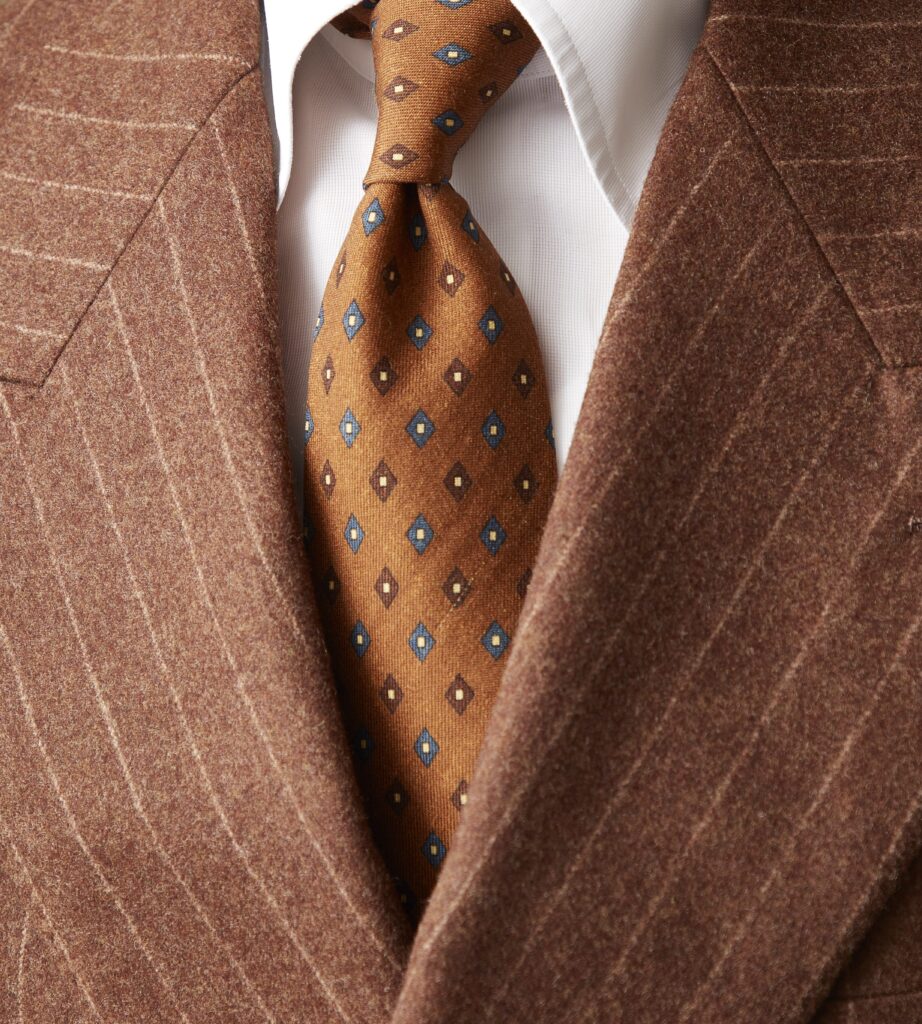
Akamine is unquestionably a master of classic style. However, with his wide lapels, deep trouser turn-ups, and other distinctive choices, I personally feel his style is less “textbook classic” and more a unique genre that could be called “Akamine-style classic.” Of course, this still firmly belongs within the realm of classic menswear — apologies if that sounds presumptuous.
Ochiai also writes that while the regular collar (around 90 degrees) falls within the scope of classic, it is not to his personal taste.
Taking all of this into account, it seems impossible to define the most classic collar angle with a single number.
If I had to summarize, I would say that anything between 90 and 160 degrees can be considered classic, while angles that are extremely narrow or excessively wide fall outside that range.
Are Variations Non-Classic?
As mentioned earlier, button-down, tab, pinhole, round, and wing collars differ fundamentally from the basic collar form and can be considered variations.
These variations cannot strictly be called classic — because they were created for functional reasons.
Buttons prevent the collar from flapping, tabs and pins lift the tie knot (I’m not entirely sure what functional purpose round collars serve).
Classic style exists on the opposite end of functionality.
Ochiai provides a very clear definition of classic style in his writing:
“Functional elements are unnecessary in classic style. Anything that originates from functional requirements can never become classic. This is a fundamental principle. Functionality is something to appreciate in home appliances or computers — not in suits or shirts.”
So does that mean that if you pursue classic style, you should never wear items born from functionality?
Aren’t button-down shirts a classic of American style? Aren’t flap pockets functional by design, intended to keep rain out?
I am not qualified to answer that definitively.
I believe that if the person wearing the suit thinks deeply about what “classic” means, and dresses accordingly with conviction, then that is enough.
At least for now, I feel that I still have a long way to go.



コメント